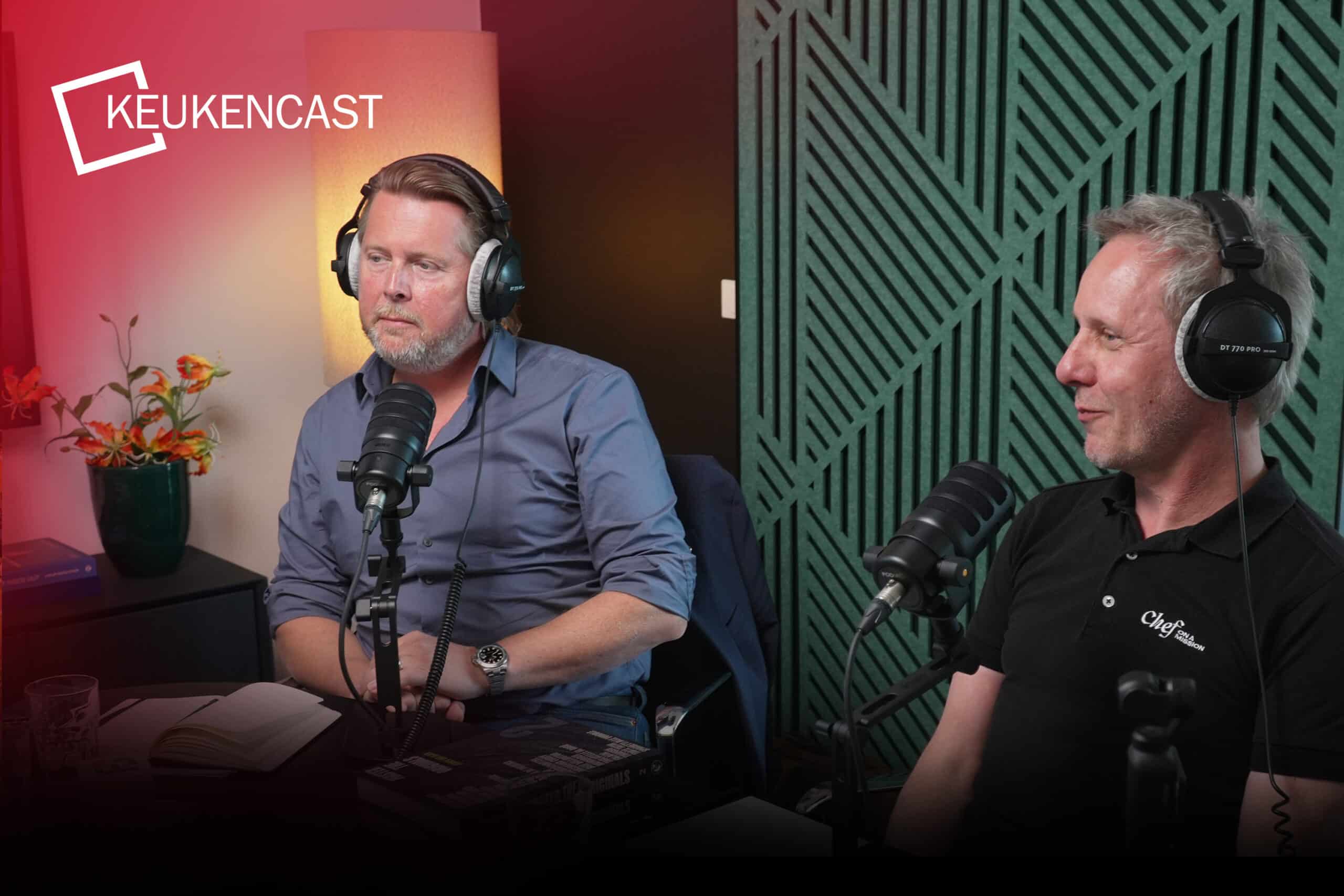
[00:03] Introduction of the Guests
Jerry Helmers: Welcome to KeukenCast, the podcast for every professional in the kitchen industry. My name is Jerry Helmers, and I’m your host and moderator. And who’s joining me in the studio today? Christian Borsboom from STEEL Benelux B.V. and Jeroen van Oijen from Chef on a Mission. We’ll hear more from you later: who you are, where you’re from, and what you have to share. But first, I’d like to ask you, gentlemen: why should listeners stick around today? Why shouldn’t they click away, and what promises are you willing to make?
Christian Borsboom: That’s a good question. I think I want to highlight not just the product, but more my experience. And perhaps people can draw on that experience during a sales conversation. I’ve been active in the kitchen industry for about 27 years now, having worked in and explored all kinds of areas. And I think that when you put all that together, it can really add something valuable.
Jeroen van Oijen: I have about 125,000 followers on social media. And I get a lot of feedback from people. They’re all hobby cooks who are into cooking and want to learn how to cook better. And I think it’s very important for kitchen retailers and kitchen installers to realize what happens with that kitchen. What am I enabling with the appliances I have installed in those people’s homes?
[02:26] Statements About Cooking and Kitchen Sales
Jerry Helmers: I’d like to present a few statements to you. You can only respond by saying whether you agree or disagree. Wouldn’t it be fun if you started to disagree with each other?
Jerry Helmers: The best kitchen consultant should also be a bit of a cook.
Christian Borsboom: I agree. That would be wonderful.
Jeroen van Oijen: I agree.
Jerry Helmers: In many showrooms, there’s still not enough talk about cooking.
Christian Borsboom: I agree.
Jeroen van Oijen: I agree.
Jerry Helmers: The culinary industry talks too much about technology and not enough about flavor.
Jeroen van Oijen: I don't visit kitchen stores every week, but I think I agree. Of course, I'm not in the kitchen industry every week. I do talk to Christian about cooking all the time, though. But I would consider it very important.
Christian Borsboom: It just depends on how you interpret it. Because I think taste… do you mean the style of the kitchen, the design, the color? In that case, more attention is actually paid to those aspects. So I don’t agree with that.
Jerry Helmers: The kitchen of the future is less about convenience and more about the experience.
Jeroen van Oijen: I agree. I hope so.
Christian Borsboom: I completely agree. I certainly hope so, too.
[04:43] Christian Borsboom's Career and the Story of STEEL
Jerry Helmers: Tell us a little bit for the few people in the culinary industry who might have been living under a rock for years and have never heard of STEEL. Who are you, what’s your role, and what does STEEL actually do?
Christian Borsboom: My name is Christian Borsboom. I’ve been working in the kitchen industry for about 26 years. I started out at a kitchen store in Pijnacker, where I really enjoyed selling kitchens. After that, I went to work for Willem van Rijn, which later became BSH. I then worked at a number of companies. We’ve now been making a name for ourselves with STEEL for eleven years.
But what exactly is STEEL? We manufacture kitchen appliances, but with a twist. We do this in Italy as a family-owned business. We’ve been doing this for over a hundred years. We’re based in Carpi, in northern Italy. There, we manufacture stoves and built-in ovens. That’s really our core business. We also produce modular kitchens for indoor and outdoor use.
Everything there is made in a special way. In fact, it’s all done by hand. Everything is assembled by a single person.
About twelve years ago, Frans-Anno Tweebeeke, who was then the former director of BSH, asked me if I wanted to become STEEL’s agent in the Benelux. I thought that was a great question, to say the least. So we started STEEL Benelux B.V. I’m a shareholder, and STEEL Italy is a shareholder. The idea was that this would allow for more influence from both sides—not just from the factory.
The fact is that when there is demand in the Dutch market or in the Benelux, we can turn that into a product fairly quickly. We’ve been doing that for years now.
Jerry Helmers: And what's Italian about you?
Christian Borsboom: I absolutely love Italian food.
Jerry Helmers: Who wouldn't love that?
Christian Borsboom: But then my heart beats in a truly Italian way, too.
[07:19] Jeroen van Oijen's Mission
Jerry Helmers: Chef on a Mission. Who are you, and what is your mission?
Jeroen van Oijen: My name is Jeroen van Oijen. I’ve been in the culinary industry for 35 years now. I’ve been cooking at all kinds of levels for a very long time and have gained a great deal of experience. I used to run an online platform for professional chefs, through which I was able to contribute to changes in vocational education, among other things.
In 2023, I launched Chef on a Mission. My goal is to track down and document the 100 most famous dishes in the world—including Italian dishes—that are enjoyed everywhere, right back to their origins. I’m on a quest to find the ultimate recipes and actually learn how to make those dishes in the right places. I’m doing this through cookbooks and online platforms.
Jerry Helmers: What’s the ultimate recipe? There’s no accounting for taste, right?
Jeroen van Oijen: That’s true. But you can assume that, at least in its place of origin, people know—based on tradition—how something should taste, how it should be made, and which ingredients to use. Much more so than people who’ve often learned it secondhand—or even fifth-hand—from books or online recipes. I really want to learn it from the ground up and pass that knowledge on.
Jerry Helmers: I see you brought two books with you. I think those are your books, right?
Jeroen van Oijen: My mission is to catalog the 100 most famous dishes in the world. The point is for home cooks to benefit from understanding the originals—to master those 100 dishes. The two books here contain the first 40 dishes. Twenty dishes per book. There will be five books in total.
Jerry Helmers: To be continued.
[09:14] The Secret to a Good Sales Pitch
Jerry Helmers: What are we going to discuss? I’d like to go over with you how to have a good conversation in the showroom. Let’s start with the open-ended question: How do you have a good sales conversation in the showroom?
Christian Borsboom: Listening.
Jerry Helmers: That's one answer, but that's where it all starts.
Christian Borsboom: That’s definitely where it starts. Listening. And really listening. Then making an appropriate offer based on that. Start by listening, and then ask the right questions.
Jerry Helmers: Are kitchen showroom salespeople in the Netherlands good listeners?
Christian Borsboom: I think most of them do. Because if you don’t listen carefully, you can’t make a good offer. Then you won’t be successful, and you won’t be able to keep it up. So I think most of them are good listeners. The challenge lies more in how you get consumers to ask certain questions on their own.
Jerry Helmers: Could you give an example of that?.
Christian Borsboom: A customer walks in looking for a new kitchen. They have a specific vision in mind: design, color, appearance. Ultimately, what matters is whether they’ll enjoy cooking in it—or whether they even like cooking at all. Those are the best questions to ask at the beginning.
Of course, there are also people who don't like it at all, but who do need a new kitchen. If you don't know that, you can't make a good offer.
[11:44] Asking Follow-Up Questions About Cooking Habits
Jerry Helmers: Jeroen, do you agree with this? That a showroom salesperson should, above all, be able to listen and then ask questions?
Jeroen van Oijen: I’m the last person to say that salespeople aren’t doing their jobs well. But I do think it’s always important—no matter what industry you’re in—to know what’s on your customers’ minds. What’s on the consumer’s mind? What are they going to do with it at home? You can easily ask follow-up questions to find out: are they really passionate about cooking? If so, I think you’ll recommend something different. Especially when I look at STEEL’s products. You sell those to people who are passionate about cooking, who want sturdy, reliable appliances, and who aren’t just looking for sleek, minimalist design.
Of course, I don’t sell kitchens, but I do talk to people a lot. And when I talk to hobby cooks, I always try to figure out right away: what’s your skill level, and what do you want to achieve? Do they want to cook 26 times a year—which is what most hobby cooks do—going all out once every two weeks? Or do they actually cook every day? Do they cook to nourish themselves, or do they just cook for show?
Jerry Helmers: Do they cook to nourish, or do they cook for show?
Jeroen van Oijen: Yes, of course there are people who just want to make sure there’s food on the table every day. And there are people who want to go all out and show what they can do. And create something. In that case, I can imagine that you have different needs than someone who just wants a kitchen because a house has to have one.
[13:19] A role-playing game in the showroom
Jerry Helmers: Actually, I just had an idea. How about we pretend we’re in a kitchen showroom? My name is Jerry Helmers, and I walk in. By definition, I’m a difficult customer—a difficult potential client. And I’m going to sit across from you. Then you’ll have two minutes to try to sell me a kitchen.
Christian Borsboom: So, nice and spontaneous.
Jerry Helmers: Nice and spontaneous. Well, goodbye, gentlemen. Good morning, good afternoon, or whatever it is.
Christian Borsboom: Hello, Jerry, and welcome to our kitchen showroom. You'll see plenty of kitchens here.
Jerry Helmers: Yeah, I can see that. But that's a lot of money. Expensive, expensive, expensive.
Christian Borsboom: I think the key is to try to have a conversation with consumers that they didn’t really expect themselves. To spark their interest based on all the things you can do with that kitchen.
Jerry Helmers: So how would you trigger me?
Christian Borsboom: I’d really ask: Do you like to cook? And I don’t mean just talking about the kitchen itself right away, but about everything you can do in it. I always find that a much more enjoyable conversation. Based on that, you can build something around it. Of course, eventually you’ll end up talking about design, colors, and the layout, but by then you’ve already established a different connection—a bit more depth in your conversation. That’s much nicer than jumping straight to the models, colors, and countertop materials.
Jeroen van Oijen: I'd like to know: do you like cooking, or do you like eating?
Jerry Helmers: I especially love food. I sometimes find cooking a bit of a hassle. It takes a lot of time.
Jeroen van Oijen: And do you have someone—do you have a partner who actually likes to cook?
Jerry Helmers: No, if that were the case, I would be making this appeal right now.
Jeroen van Oijen: Then I’d ask further: What do you do in that case? Do you go to a good caterer? Do you have a meal delivery service come over? Do you have a meal kit delivered? What are you going to do next to feed yourself? And what kind of equipment will you need? Do you maybe cook with your friends once in a while, just because you enjoy it? If so, there needs to be a way to make that possible.
[15:33] Do consumers know what they need?
Jerry Helmers: Do people actually always know the answers to the questions you’d ask, or the ones the kitchen showroom salesperson asks in the showroom? Because that’s pretty complicated. Do consumers even know that themselves?
Christian Borsboom: I don’t think so. They’re far too preoccupied—which I understand—with the media and magazines. Everywhere you look, it’s all about appearances. That often makes you think everything revolves around appearances, but that’s not true at all. It’s about depth. Not just between people, but simply: what do you want, and why are you doing that? That’s a much more interesting conversation. Of course, the other aspects come into play as well, but then you have a good match. It might also be that, from STEEL’s perspective, it’s not a good fit. That’s perfectly fine, too.
Jerry Helmers: What kind of customers are a good fit for you, and what kind of customers aren't a good fit for you?
Christian Borsboom: That’s why we’ve really focused on building partnerships. Customers who truly love cooking and enjoying each other’s company. It’s not always the case that everyone in a couple loves to cook. If one person doesn’t like it and the other does, they’ll still end up eating together and cooking together in that kitchen. In that case, they could be a great fit for STEEL.
Jerry Helmers: Maybe the consumer isn’t in the mood for that kind of conversation. The customer might still be in the mindset of: “I’m here to buy a kitchen. It has to be Japandi-style—if the customer even knows what Japandi is—or I want marble countertops in such-and-such a color.” Does the customer walk in with that mindset?
Christian Borsboom: At first, yes. Of course, they come to the store because they were drawn in by the brochure or online content. It’s not the in-depth conversations that are posted online. So initially, that’s how they come in. And then it’s really nice when the conversation can be taken a step further.
Jerry Helmers: But are they really up for that, for that level of depth?
Jeroen van Oijen: I think the salesperson needs to ask the question. If you find out that these people just want a beautiful, stunning kitchen to complement a beautiful home, then you have a completely different conversation. It’s a kind of pre-screening. Someone who buys a STEEL stove is different from someone who wants a sleek countertop with an induction cooktop—no range hood above it—a steamer, and a microwave built into the wall. It has to look sleek above all else. That’s a different type of customer.
[18:16] Honest advice around the table
Jerry Helmers: Should a showroom salesperson and a kitchen salesperson actually have the guts to say at some point to the customer sitting across the table from them: “I think you’ve come to the wrong place”?
Christian Borsboom: That’s usually not necessary. Most specialty kitchen stores carry a variety of styles, so you need to tailor your selection accordingly. I think honesty is the best policy in the long run. It definitely pays off. There’s absolutely no point in going along with a particular aesthetic preference if, in practice, it might not work out well for those people at all.
[19:12] Differences Among Customers
Jerry Helmers: Do you see any differences between men and women? A married couple is sitting across from you at the table. You have a lot of sales experience in the showroom. Do you see any differences between men and women, and if so, what are those differences?
Christian Borsboom: I don’t know if it’s necessarily a man or a woman. But I do think that in a couple, there’s always one person who makes the decisions. I always found it quite an experience when they didn’t agree with each other. Then you’re kind of caught in the middle. Usually, you can work it out with a laugh. A little friction adds some sparkle. In the end, you come up with something that really suits them.
Jeroen van Oijen: Let’s take a moment to look at how they view the kitchen. From what I know: I have a lot of conversations with home cooks. I’ve noticed that men—who make up about sixty percent of my target audience—are much more concerned with whether something is cool, sturdy, and packed with gadgets. They want as many appliances as possible. I’m talking about hobby cooks here, not men who don’t like cooking at all.
Women are generally more concerned with: Can we keep everything neatly organized? I don’t mean that in a stigmatizing way, but that’s just how it is. There are also female hobby cooks who feel that way, but in general, it’s really the other way around.
Jerry Helmers: Why do you focus more on men?
Jeroen van Oijen: It just happened naturally. People who cook as a hobby—who really put effort into it, who delve deeper, want to buy equipment, and want to explore techniques—are generally more men than women. That also has to do with the fact that most women cook more with a focus on care. That’s not meant as a criticism, either. But the men who read my books do indeed want to put a dinner on the table as a hobby 26 times a year.
Christian Borsboom: It’s kind of funny, isn’t it? You see that all the time with barbecues, for example. You always see guys acting all tough in those leather aprons.
Jerry Helmers: Acting tough.
Christian Borsboom: Why No Women?
Jeroen van Oijen: There definitely are some, but it's just a smaller percentage.
[22:08] The Kitchen Consultant as a Chef
Jerry Helmers: You both said in response to the statement: “The best kitchen consultant should also be a bit of a cook.” What exactly do we mean by that? Should they be knowledgeable about both home cooking and cooking for guests?
Christian Borsboom: I think the essence of a kitchen is to cook in it. If you’re a bit of a cook, that definitely helps. Then you can see if the design and layout are practical. So for that reason, it’s nice if the salesperson is also a bit of a cook.
Jerry Helmers: Should consumers actually be able to practice in their test kitchens? Like when you buy a car and get to take it for a test drive?
Christian Borsboom: You used to have that. There were companies that made blocks that simulated the layout. That way, you could experience what it was like to be standing in your kitchen. These days, you can do that with VR glasses, too. It makes you feel like you’re standing in your kitchen.
Jerry Helmers: But when you talk about the experience, virtual reality isn't real. You want to be able to smell it, too, don't you?
Christian Borsboom: Then they'll have to come to the showroom. Here, they can actually cook on the stoves.
[23:47] The Collaboration Between STEEL and Chef on a Mission
Jerry Helmers: So how does that collaboration between you two work? We’ve heard about it a few times already. You work together. What kind of collaboration is there between STEEL and Chef on a Mission?
Jeroen van Oijen: There’s actually a story behind that. I’m a professional chef, of course, and used to working with certain equipment. Then I had to set up my own kitchen. Almost automatically, I ended up choosing Solitaire at the time—which later became STEEL. A 1.20-meter stove, solidly built, with two ovens, large range hoods, and sturdy sinks with large spray heads. I felt completely at home with it. I just want to have good equipment. In the end, I enjoyed cooking on it and making videos for years. Christian saw that and thought, “How nice.”.
Jerry Helmers: So you guys hadn't known each other for very long? Christian, you just saw Jeroen pop up on Instagram?
Christian Borsboom: I think it was a good two years ago. That’s when we said: Listen…
Jeroen van Oijen: I could keep cooking on that stove for another twenty years, but I was going to build a new studio in Den Bosch—a more compact one, since we shoot a lot of videos. That’s when Christian said, “I’ll help make that happen.” But I did want to put myself in the consumer’s shoes as someone who cooks as a hobby. What would I do in that situation? As a consumer, I’d want closed cabinets to store things. But I’d also want that stove. We really came up with that combination together.
Jerry Helmers: Do I really need to say that STEEL Cucine is a fantastic brand?
Jeroen van Oijen: Yes. But the great thing is: I was just a user.
Christian Borsboom: That’s absolutely true. Then I ran into Jeroen, and there he was, cooking on a Solitaire. That was actually the precursor. Solitaire was a proprietary brand of Willem van Rijn, which later became BSH. They didn’t just have Bosch and Neff appliances; they also wanted to get into cooktops. That became Solitaire. It was manufactured by the STEEL factory in Italy. That’s the one Jeroen still has at home. It’s 24 years old now. Every now and then a small part needs to be replaced, but very rarely. That’s the quality.
[26:31] The Ultimate Tip for Showroom Salespeople
Jerry Helmers: What’s the ultimate tip for a showroom salesperson? What would actually be useful to them, or what would inspire them to maybe do something differently or more effectively in the showroom? Jeroen, you first?
Jeroen van Oijen: I’m going to keep asking follow-up questions. I’m not satisfied with the initial answer. There’s also a latent need that people often aren’t even aware of. That’s true for all products. Ask exactly the right questions.
Jerry Helmers: In short: be aware of a latent need. Christian, do you have anything to add?
Christian Borsboom: Ultimately, it’s all about the experience. You shouldn’t just look at the appearance, but also at those needs. You have to draw them out a bit. So: listen, ask good questions, and then you’ll find something that’s truly the right fit.
[28:29] Trends in the Kitchen Industry
Jerry Helmers: Christian, I’d like to go over the trends in the kitchen industry with you. We’re seeing all kinds of developments. What are the current trends? This could include, for example, the use of materials.
Christian Borsboom: We recently participated in STEEL at the Salone del Mobile in Milan. We had our own booth there and, of course, got to see a lot of what was going on around us. What you see a lot of are wood textures. Dark wood is a recurring theme—the rougher-textured kind. It’s quite beautiful to look at.
We also saw a lot of steel. Stainless steel is making a comeback.
Jerry Helmers: That's a positive development for you.
Christian Borsboom: Yes, definitely. What you also see is that warm tones are making a comeback. Things always come back. You see that time and time again.
Jerry Helmers: Can you explain why those warmer tones are suddenly making a comeback? We’re recording this podcast in 2026. Where does that come from? Is it because the world is so turbulent?
Christian Borsboom: That’s a good question. I have no idea. Apparently, in the automotive industry, when the economy is struggling, more colorful cars are actually sold. When the economy is doing very well, a lot of gray and black cars are sold. Maybe it’s a kind of compensation—people feel the need for something more colorful and cheerful.
Sometimes, after a certain period of time, you just need something new. At first, our approach was Japandi. Now you can see that evolving into something rougher and darker.
Jerry Helmers: What does the showroom salesperson say: “If you still have this in your showroom, things are going to go wrong”?
Christian Borsboom: High-gloss black with gold handles. That’s not really the look of today anymore.
Jerry Helmers: Should he be out?
Christian Borsboom: If it's still there, it has to go.
[30:35] Authenticity as a Food Trend
Jerry Helmers: Jeroen, it's your turn: What are the current food trends?
Jeroen van Oijen: Authenticity.
Jerry Helmers: That's a very general term right off the bat.
Jeroen van Oijen: I wasn't finished yet. Authenticity is becoming increasingly valued. By that I mean that people are looking for the original. That provides a sense of security.
There are so many variations on dishes that we all actually love. Plenty of people are sharing their own versions of them. These days, that’s really easy to do on social media. Anyone can claim, “This is how it’s done.”.
People are wondering: What's the right way to do this? I just want to know how to make it authentic.
Jerry Helmers: Give me an example.
Jeroen van Oijen: Pasta carbonara. There’s a lot of debate about it. Should you use cream or not? What kind of bacon should you use? These are discussions that come up all the time.
But who’s having this discussion? On one side are the purists, often Italians. On the other side are people who prioritize convenience. Many food influencers focus mainly on the idea that you can make anything in five minutes. That’s not true. It requires attention. And the right ingredients.
What’s the right product? Do you need guanciale instead of pancetta? What kind of pasta should you use? Should you add cream or not? And most importantly: why?
Not only do I share the authentic recipe, but I also explain why it’s done that way—so you understand what you’re doing. I think people want to understand why they do things.
[32:41] Specialization and the Origins of Dishes
Jerry Helmers: Italian dishes are always a hit, of course. I live near Amsterdam myself. What I’ve noticed is that these days, you’re expected to have eaten at a Turkish restaurant at least once. Turkish cuisine seems incredibly popular. Do you agree?
Jeroen van Oijen: What I think is happening is that there used to be a lot of so-called European restaurants. Then came French cuisine, followed by Japanese influences and Middle Eastern influences. It’s all blending together.
People are increasingly looking for specialists—a real Turk, a real Afghan, or a real Italian. That’s when you get to taste how it’s really supposed to taste.
If you've always been used to a certain idea of what a dish should be like, and then you go to someone who makes it truly authentic, you suddenly realize: this is how it's supposed to taste. That's incredibly satisfying.
Jerry Helmers: Does that include the service? Do you have to be served by Italians in an Italian restaurant? By Turks in a Turkish restaurant?
Jeroen van Oijen: Yes, because otherwise I don't trust it.
Jerry Helmers: Really?
Jeroen van Oijen: I would never open an Italian restaurant myself. I learned how to make pizza in Naples from the best. I learned all those pasta dishes right where they originated. But I’d still like to see an Italian there. That’s part of the experience.
Jerry Helmers: Then you have to speak a little Italian, too.
Jeroen van Oijen: Yes. Al dente.
Jerry Helmers: In short: back to the roots. Discover what the real recipe looks like.
Jeroen van Oijen: Exactly.
[35:08] What will the kitchen look like in 2036?
Jerry Helmers: We’re recording this podcast in 2026. In ten years, we might be sitting here again. What will the kitchen look like then?
Christian Borsboom: I find that a really tough question.
Jerry Helmers: You're definitely in the culinary business.
Christian Borsboom: That's true, but trends also come back around. We all think that in ten years everything will be totally high-tech, with floating cabinets and you name it. But a lot of things just come back around.
Maybe that high-gloss black kitchen with gold handles will be all the rage again in ten years. The look might make a comeback. But you’ll always need a countertop. And cooking remains the heart of the kitchen.
Maybe everything will become even more integrated with the living area. You can actually already see that happening. The kitchen and living room are becoming more and more open-concept. But who knows—maybe in ten years we’ll go back to separate kitchens. I have no idea.
[36:40] AI and the Role of Technology
Jerry Helmers: Jeroen, could you spice it up a bit?
Jeroen van Oijen: I think it’s going to be—and needs to remain—very functional. I’ve been thinking about what AI will do. Will we soon have smart devices that we can tell to “cook that chicken to perfection”?
I do believe that some of that will happen. That the content will just end up in the kitchen and help us out.
But I also believe that people increasingly want to make things themselves.
Jerry Helmers: Do you think home cooks will embrace AI or avoid it?
Jeroen van Oijen: Maybe “AI” isn’t even the right term. But available content and information will increasingly be incorporated into devices.
Soon, you might be able to see exactly how to cook something right in the oven—how to roast that chicken, for example—with core temperatures and all the bells and whistles.
But I also think people want to keep creating on their own. That remains important.
Christian Borsboom: Perhaps that’s precisely why it’s becoming more important for people to actually do things themselves. You can already see this with bread baking, fermentation, and trends like that. Though, of course, with the help of good equipment.
Jerry Helmers: So good equipment is becoming more important, but that equipment must continue to facilitate creativity.
Christian Borsboom: Yes.
[38:39] The commercial block
Jerry Helmers: Are you ready for the “Loekie de Leeuw moment” in this podcast? Ninety seconds of free-speech time.
Christian Borsboom: The kitchen market is under quite a bit of pressure. That’s why it’s important to try to attract consumers by helping them make informed choices—choices that truly suit them.
That depends on how you plan to use that kitchen. I think STEEL appliances are distinctive and can be a great way to support that.
We manufacture STEEL appliances in Italy. They are crafted by a single person, who puts a great deal of love and care into each one. I believe this can help create a unique kitchen and, in turn, assist the salesperson as well.
Jeroen van Oijen: If I had to talk about STEEL, I’d say: I’ve been using a Solitaire stove for 25 years now, and I just can’t seem to break it. That says a lot.
But more importantly: make sure you have a kitchen with appliances that suit you—appliances that are practical—so you have everything you need to feel relaxed while cooking.
And to create beautiful things that bring joy to others. Then you have a hobby that’s not just for yourself, but also for the people around you. And I think that can be very fulfilling.
[40:43] Cooking Brings People Together
Jerry Helmers: Can we say that cooking brings people together? You often hear that music brings people together, art brings people together, and culture brings people together. Does cooking bring people together, too?
Christian Borsboom: Yes, definitely. It's a lot of fun to cook with your friends and loved ones. I think that's one of the best things.
[41:10] A Look Back at the Conversation
Jerry Helmers: What did you think of being our guests here in Weert? We spent about three-quarters of an hour talking about cooking, kitchens, and the kitchen showroom salesperson. Did we cover all the topics we wanted to cover?
Christian Borsboom: A lot. A whole lot. I really enjoyed it. Thank you for that. We talked about some interesting things. I could have kept going for another hour.
Jerry Helmers: I'd already thought of that.
Jeroen van Oijen: Absolutely. I think people kept listening. But I just think it’s really important to talk about the purpose of the kitchen and the appliances. And I think we did that today, so I’m satisfied.
Christian Borsboom: Actually, there’s one more thing I forgot to mention. Every consumer who purchases a STEEL stove or oven—or the salesperson who sold it—will receive a masterclass with Jeroen and a two-month trial subscription as a gift.
Jerry Helmers: So actually, you didn't have ninety seconds of commercial airtime, but a hundred.
Christian Borsboom: Sorry.
Jerry Helmers: I'll send you a payment request.
[42:55] Closing
Jerry Helmers: Gentlemen, thank you once again for coming to the studio. I’m sure we’ll meet again sometime soon. But I found these fifty minutes very inspiring.
I assume that the kitchen showroom salesperson who listened to this podcast has gained some great insights to make his own work even more enjoyable. But he does need to learn how to cook. That’s one thing that’s for sure.
Jerry Helmers: Well, gentlemen, thank you for joining us. I’d also like to say to all our listeners: thank you for listening. You’ve been listening to KeukenCast, the podcast for every professional in the kitchen industry. Brought to you by Louwers Mediagroep in Weert.
The project manager is Folkert van der Werf. Daan Halters is in charge of technical operations. My name is Jerry Helmers. I was and am the host and moderator.