Platform about design and technology in the kitchen, home, and bathroom industry

That a kitchen worktop is an important component in the kitchen has long been no secret. It is also well known that a kitchen worktop is available in different materials, thicknesses and colors. Yet it appears that consumers who come to choose their new kitchen are not sufficiently aware of the options. So clear communication about the pros and cons and the specific properties of each material is needed. The picture must be right.

Which kitchen worktop is the best choice? Not an easy question to answer, because try to give an appropriate answer to this. And yet it is up to the kitchen specialist to do so. A kitchen worktop is one of the most important elements in the kitchen, it is the "device" with the largest surface area, and therefore it also gets the most abuse. Together with the customer -the end user of the kitchen- dwell extensively on the expectations of the worktop, and be sure not to rush into choosing a particular material. Properties such as ease of maintenance, hygiene and durability will probably be popular answers when asked what customers expect from their worktop. But the list of possibilities is, of course, longer. So discuss not only what material exactly, but also what shape or height is desired.

A worktop is always custom-made. Because the cliché is true; every home is different so every kitchen is also different, moreover, the people who live there are also different from the neighbors. So that makes every kitchen unique. Therefore, it is very important to pay due attention to the worktop, as well as the sink, the kitchen faucet and all appliances, of course.
Most innovative, however, is the emergence of rounded kitchen islands. After curves in sofas and rugs, this trend now translates to the kitchen. Straight has become boring and we want more life in the kitchen. A handy "side benefit" is also the added safety of rounded corners when there are (smaller) children running around the house, and thus also in the kitchen.

Worktop height is of ergonomic importance. You will only stand at a worktop and find that it actually could have been a little higher for a good working position. There is of course a standard height, but this can be deviated from as desired. The best scenario, of course, is to put it to the test and have the customer perform some actions at a work surface. Such as cutting vegetables and stirring in pots and pans; the traditional and most common actions in meal preparation.
Only then will you know what height really works for that particular client.
Customers expect to have choice in worktop material and color. After all, that is what every visitor will see at home. Especially now that the kitchen and the living room are merging into one and the kitchen has become the centerpiece of the home. A worktop does not hide as well as the various appliances. The atmosphere and style of the kitchen depends largely on the choice of worktop. So there is much more to consider than just its functional properties. In terms of materials, of course, we all know what the most common (or most commonly mentioned) are: natural stone (granite, bluestone, marble,...), composite, ceramic, Dekton, stainless steel (or stainless steel)... But worktops made of glass, wood or concrete are also among the possibilities. The latter is available in all shapes and sizes and, of course, is not limited to the kitchen alone. Concrete countertops are also possible in the garage, bathroom or hobby room. The advantages of a concrete kitchen worktop are that it is robust and resistant to scratches, heat, pressure and dirt. This is because concrete is naturally hard, smooth, hard-wearing and resistant to heat and stress. Polished (or floored) concrete is also less prone to stains and easier to clean.
Neem dan rechtstreeks contact op met Jetstone.
 Contact opnemen
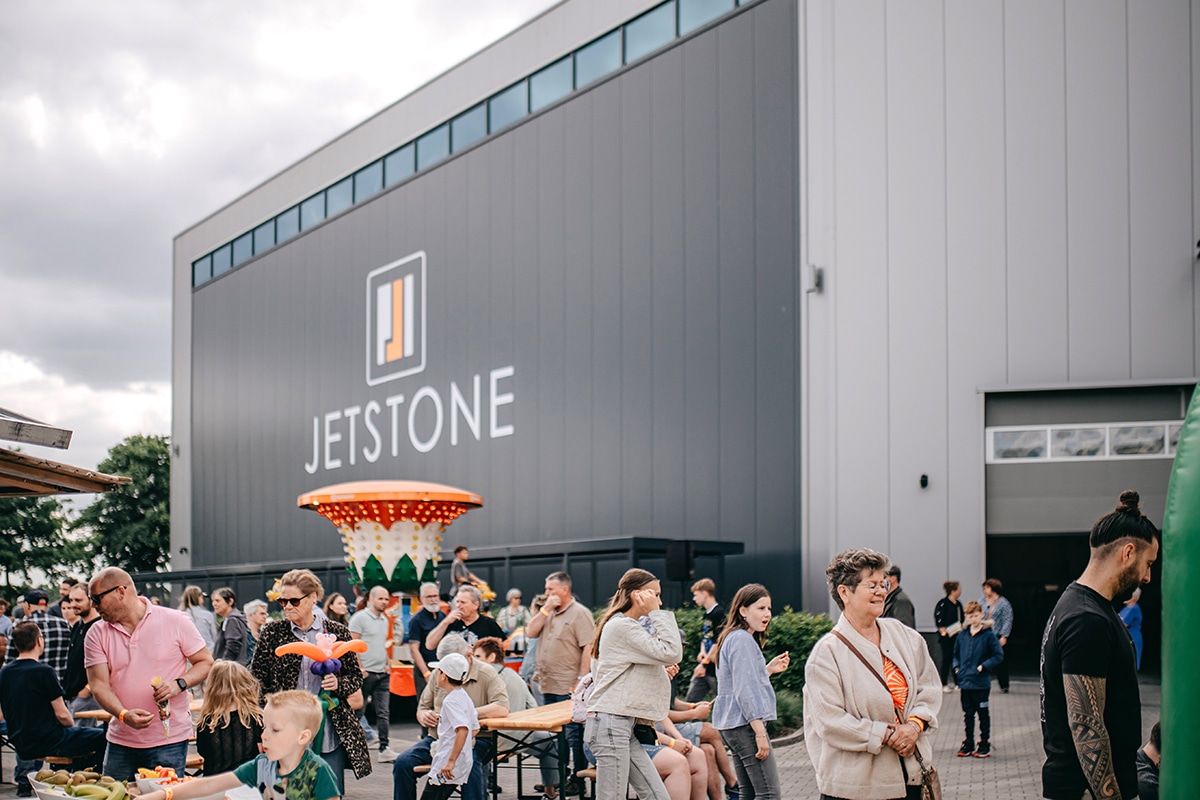
Since its founding in 1993, Jetstone has steadily grown into a highly reliable, international cooperation partner for granite, composite and ceramic countertops. The sustainable manufacturer now has two modern production sites and a third (of 16,000 m2) under construction. Among its more than 300 enthusiastic and committed employees, there is a sizeable team of in-house fitters who [...]
Bekijk Bedrijfsprofiel