Transcript
[00:02] Introduction of the episode
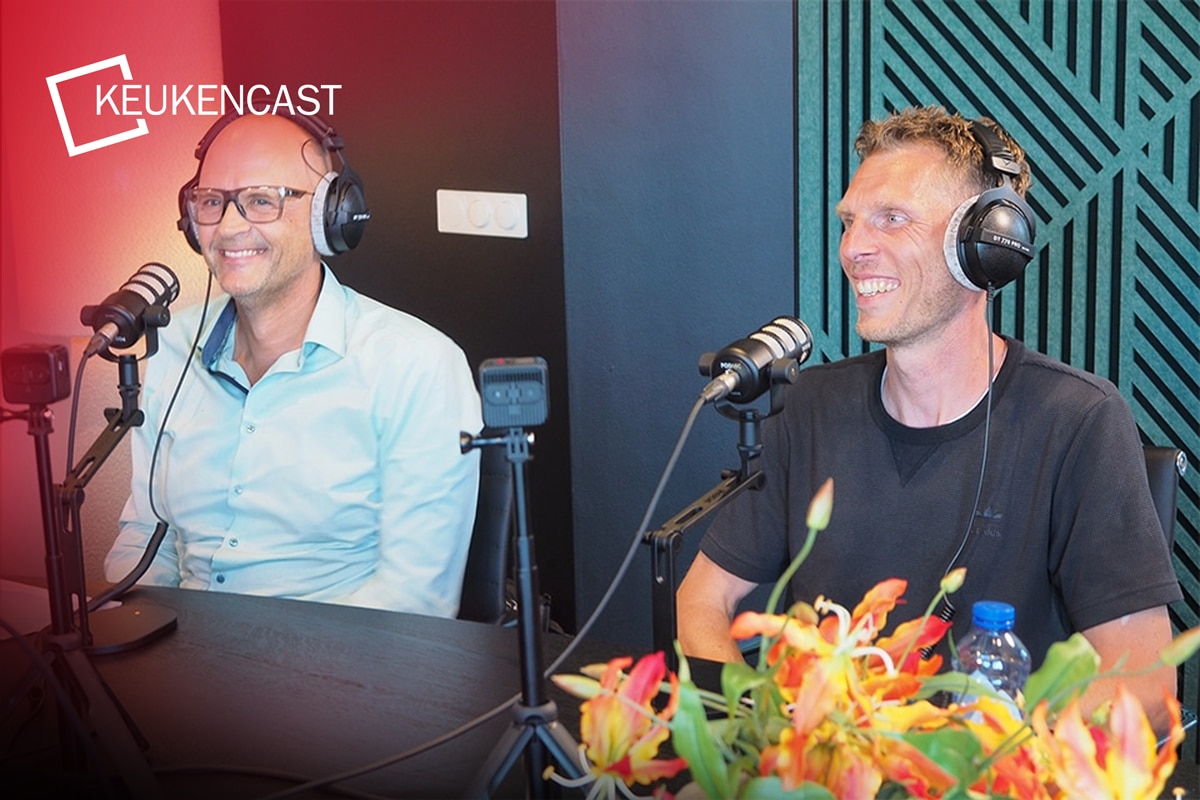
Jerry Helmers: This is KeukenCast, the podcast for trade professionals with ambition in the kitchen industry. In each episode, an expert joins us to discuss the most important trends, themes and developments. And we don't shy away from discussion either. At the kitchen table, on the kitchen table, under the kitchen table, we do it all. My name is Jerry Helmers, I am your host and presenter. You're most welcome. Yes, dear listeners, this may be going to be a podcast with a lot of confusion. My name is Jerry Helmers, but so we also have a guest here in the studio right now already and his name is also Jerry. Who's name is not Jerry Helmers, but Jerry Severins. Yes, welcome. How are we going to do this? How are we going to keep this apart for the listeners?
Jerry Severins: We will look at each other well and we have good coaching on the other side.
Jerry Helmers: I have confidence in that.
Maarten Zegstroo: It is also confusing only to me.
[00:52] The guests at the table
Jerry Helmers: Yes, Martin, there you are already indeed. Our sidekick, our kitchen guru. You're also going to soon be in the middle of this podcast utilizing Maarten's Minute, your column. And so then Jerry and Jerry are going to respond back to that. Well, I'm very curious about it. But Jerry, other Jerry, Jerry Severins, before I start presenting you with some statements, will you tell me who you are, where you're from and what brought you here to this podcast?
Jerry Severins: Yes, that's a nice one. I am indeed Jerry Severins, 50 years old. I always say a proud Hagenees. Father of two great sons. Important in life, privately, the boys, soccer. I am in the home furnishing business for a long time. I started out in interior design, specializing in kitchens. Then made the move to Wave Design, extractor hoods. For sixteen years I was able to fulfill my role there as co-shareholder. Stepped down since last year, of course kept in touch with the kitchen industry, including you guys. And I saw this podcast recently with the predecessor Martin. Great, wonderful what you guys, the initiative you're taking for the kitchen industry.
[02:09] The step to enlightenment
Jerry Helmers: But then what do you do now in daily life, which is linked to the kitchen industry?
Jerry Severins: Yes, last year I had my transfer of shares. Grabbed a moment of rest for myself. And at that time I started to specialize in lighting. And lighting primarily for the kitchen industry. Of course, I'm open to pulling it broader, but my start will be in the kitchen industry, which of course I know well.
Jerry Helmers: We're recording this podcast now in the spring of 2025. You're about a year into your new business now. That's roughly how we can conclude it.
[02:31] Maarten introduces himself
Jerry Helmers: Maarten, for the few people in the Netherlands who have never heard of you. I said it before, you are a bit of a kitchen guru. And I'm very proud that you're my sidekick. Please introduce yourself.
Maarten Zegstroo: I am Maarten Zegstroo. Privately also very important, two lovely daughters, Evi and Fine, twelve and fourteen years old. Fifteen years working in the kitchen industry. I was editor-in-chief of another trade magazine. Been away from it all for a year. And now back in the kitchen business at Keukenbouw.
Jerry Helmers: Yes, and you'll have your column later in the middle of this podcast, Maarten's Minute. You don't have to say anything about that, of course. We also literally don't know what you're going to say yet. But where do you get your inspiration to make that column later on tantalizing and pronounce it here full of verve?
Maarten Zegstroo: In general, I know most of the companies that are here well. There's always a question or an opinion somewhere on my hard drive there. And that's where I start.
Jerry Helmers: I see you balancing words now, because you don't really want to give away....
Maarten Zegstroo: No, no.
[04:14] The first propositions
Jerry Helmers: Right, well, you always end your column with a question for the guest. Right. We'll be surprised later, because I literally don't know what you're going to do either. No. What I do know what I'm going to do is present you with the statements. Namesake Jerry, may I present the statement to you first? You can only answer agree or disagree. I love it when people say, come on indeed. So that bodes well. Coming up with the first proposition. Kitchen salespeople know too little about light.
Jerry Severins: Agreed.
Jerry Helmers: Agreed, Martin, what would be your response to that?
Maarten Zegstroo: Agreed.
Jerry Helmers: Agree, well, at least you agree with each other on that too. Next proposition. Functional light and aesthetic light are almost never balanced. Jerry?
Jerry Severins: Disagree.
Jerry Helmers: Disagree. And what do you say, Martin?
Maarten Zegstroo: Agreed.
Jerry Helmers: Agreed, could be fun. And then the last proposition for this moment. I'm going to ask Maarten about it first. Then Jerry will have a little more time to think about it. Maarten, the wrong lighting plan can still ruin a perfectly designed kitchen.
Maarten Zegstroo: Agreed.
Jerry Helmers: And what do you say Jerry?
Jerry Severins: Agreed.
Jerry Helmers: Agreed, indeed. Okay. Theses were not that difficult I believe, were they?
Jerry Severins: No, we can have those.
Jerry Helmers: Was still manageable. I still have some reserve positions. Maybe I'll come back to that later then indeed.
[05:29] What does light do to people?
Jerry Helmers: We're going to talk about light in the kitchen. Maybe the psychology of light. Jerry, what does light do to people?
Jerry Severins: Yes, light, of course, is a huge concept. Light is something that we all deal with on a daily basis. Light is life, you could almost say. Light is great. Light determines mood. Light determines how you can look at the situation. It is literally someone, their well-being, how you function. Light does a lot. You notice lately that there is also much more study on that, that people are talking about that, discussing that. And we can do that here as well. Light is constantly around us. And certainly in the interior design field, there's a lot of catching up with that. So a little bit of an understudy. And also maybe logical.
Jerry Helmers: Yes, but why is it that it has been an underserved child?
Jerry Severins: I think the focus becomes more obvious on lighting now, because the kitchen, I think for a moment maybe twenty years ago, was hidden in the back of the hallway, behind a door. Yeah. And you walked into the kitchen and that only had one function. You had to make your potatoes, vegetables and meat there. Yes. And that was basically it. The kitchen changed. The wall became half-high at one point. The door that disappeared. The kitchen became open. So then exposure from the living room, of the whole room, takes on a different definition. And now when people build or buy a home, they actually immediately say centrally: hey, where is the kitchen going to be? And it's also literally central to the home. In the home there where you move, where your traffic areas are, where you come home, where you relax again, where you might want to watch TV, where you want to communicate with the kids. So a whole lighting plan takes on a different role than it's in the back of the hallway, that you might be in the kitchen for forty minutes.
[07:26] Playing more with light
Jerry Helmers: So you can play a lot more with light?
Jerry Severins: You will have to play much more even with light.
Jerry Helmers: Yes? Why have to?
Jerry Severins: Because it used to be purely functional. It was go into the room and make the potatoes, vegetables, meat, go back into the dining room and feed the family. That's where it ended.
Jerry Helmers: But you said because well-being in the living room, living room, combined kitchen, that's where well-being takes place.
Jerry Severins: Yes, this has become a combined environment.
[07:45] How Maarten experiences light at home
Jerry Helmers: How do you see that, Martin? How do you experience light? Do you have an open kitchen yourself?
Maarten Zegstroo: No, I have a semi-open kitchen. I live in a very old house, a real 1930s house. Where the shed used to be, that's now my kitchen. So the door is gone, but it's not part of my living room.
Jerry Helmers: So is it still purely functional with you? Also when you look at the light in your kitchen?
Maarten Zegstroo: That's also what I want to say. I use the light purely as a functional light. To easily cut my vegetables.
Jerry Helmers: Being able to look into the pans.
Maarten Zegstroo: To be able to look into the pans. And of course that's different the moment it becomes a part of my living room.
[08:39] What is the biggest misunderstanding about light?
Jerry Helmers: Yes, exactly. Jerry, what is the biggest misunderstanding that you encounter among consumers and kitchen salespeople about light in an interior? Or in other words, what should kitchen salespeople in kitchen specialty stores, which is after all our biggest target audience in terms of listeners, what should they know more about light in their sales conversation or consulting sessions in the showroom?
Jerry Severins: No, step one is I think they need to start taking the advice with them. Right now it's mainly about the kitchen layout, it's about appliances, it's about the countertop. And yes, still functional then actually.
Jerry Helmers: Sure, but those are also very functional devices where you work. A water source is a functional product.
Jerry Severins: Yes, even though that can look very nice. Because that space has now become one, so the dining room, the living room, the kitchen has become one space, it's expected I think, I don't have a crystal ball, but I do assume that more time, more energy has to be put into lighting. Because otherwise from a living room you get the wrong view of the kitchen. And that has to do with the functional, possibly the aesthetic. I see beautiful environments coming by. I see insane homes. I see insane kitchens displayed. And the lighting plan is just not finished.
Jerry Helmers: Okay, but do kitchen salespeople know this? Because that's also my question, what's the misunderstanding?
Jerry Severins: No, until the last period, lighting hasn't come up emphatically in the kitchen industry. There are lighting specialists coming in, of which I am one myself. There are total suppliers who are going to pick up a piece of lighting. So it's also unknown yet to that vendor.
[10:13] How do you increase that knowledge in the showroom?
Jerry Helmers: How does that kitchen salesman in the showroom brush up on his knowledge in such a way that he can actually give serious advice?
Jerry Severins: You can do that through on-site training. So when I go somewhere, and speaking for my own parish, when I go somewhere I bring props, I show them, you take them into the world of enlightenment. And that's beautiful too. Then you often get the o yes's. Ah, I never thought of that. I didn't take that opportunity.
Jerry Helmers: Give an example of that. If you say, when you hear a reaction like that of, oh, now that you tell it, I never thought of that.
Jerry Severins: Well, an easy example is, which is already so simple, is that people say, I'll have an aesthetic lamp over my kitchen island. I have a nice country pendant. Well, top, you've done well. The pity of that, though, is that you light your kitchen island well. So the countertop, my workspace. Unfortunately, the front of your kitchen, which you just pay a lot of pennies for, you don't illuminate that. So you should dare to think even further of: okay, I've lit my countertop. But do I want that beautiful front, which I paid a lot of pennies for, do I want to maybe light that as well? There have also been situations where people say: well, I'll take a beautiful rail over my head. Then I get there and I say: yes, that rail is nice what you've done, but you're standing in your own light. So still a dark spot on your sheet. The moment you start explaining that and you add some drawings and sketches, you add the plan, they say: yes, I've never understood it that way. That's ultimately what the kitchen salesman in the showroom has to do.
[11:38] Light during the day and atmosphere in the evening
Jerry Helmers: Definitely. But Maarten, how do you see that? Also focus on lighting the countertops or the fronts?
Maarten Zegstroo: I think the challenge lies, and it may actually have been there for years, but now it's getting attention, is that the kitchen is generally sold during the day, is placed during the day. So then lighting is an undershot. And it used to be easy, of course, because there were bulbs in the hood, so there was a ceiling light hanging for that functional light. But so now you have daytime light, so to speak. The kitchen during the day.
Jerry Helmers: Are you saying it's almost already not brought up? Or is it forgotten?
Maarten Zegstroo: I think that is forgotten, unconsciously. Because we have been selling open kitchens for a while, but here it is not considered that you have a daytime moment with your kitchen. You also have an evening moment that you want to use it. So you still have to have that light, because otherwise it becomes difficult to prepare your food. But you also have a moment when you're done eating or going to eat and you want atmosphere back. So actually maybe instead of having two moments, functional light and ambient light, there might be a third moment.
Jerry Helmers: But so interestingly, how would those kitchen specialty stores solve that? Also that they say to the customer of, come over here at night to see this setup when it's dark outside?
Jerry Severins: No, that's not going to happen. It's always in the knowledge of the consultant, of course. I'm confident that a piece of lighting will become a chapter in their design, in their advice.
[13:32] Can you properly explain mood lighting in the showroom?
Jerry Helmers: Yes, yes, but just one step back. If you say at two o'clock in the afternoon you receive that consumer in the showroom, then of course, as a kitchen salesman, you can have so much expertise about light, but you can't really show it, the experience, because even at two o'clock in the afternoon, even in the Netherlands, it's still extremely light outside.
Jerry Severins: That's right. Of course, there is always trust between the buyer and the seller. The seller will take the buyer's advice. And the technology will also dance with that. So when I talk about a hybrid lamp, just so to speak, that can handle both the functional, the mood moment can handle that, through a dimming function or color change. Then you can present that to the consumer of: this lamp is ready for any time of day. The morning is different from the evening. Even though maybe the sun is at the same height, it's different.
Jerry Helmers: I would then as a consumer, if I were made aware of that, I would really want to see it at night still. Because you were already talking about pennies being spent. Then I also want what my money's for. I do want to know what I'm buying. All open in the evening, those kitchen stores?
Maarten Zegstroo: Is that always the case, Jerry? Because you also buy a furnace based on your advisor's advice. So you can also have lights installed based on your advisor's advice.
Jerry Helmers: But when I buy an oven, I buy an oven because I want to know that the chicken is going to roast properly, and there it doesn't matter if I have light or no light.
Maarten Zegstroo: Then you eat only then you also can't see if that is done your way the way you want it to be done.
Jerry Helmers: Then I don't understand what you mean now.
Jerry Severins: Let me say then, if you are then my consumer and I have to give you that advice, there are always some tools that you can use. Like my speech, like my examples, like my numbers, to be able to convince customers though. I think when you talk about ambience, so that evening after the shopping you want to do, I would dare to ask the question back: when is your home most ambient? Then I think 95 percent end up with candlelight. I think it's warm when something is glowing, that's cozy, that makes me feel safe, that's a good environment. There is a... you can make that very hard by means of kelvins, of colors. Then we talk about 700 kelvin, for example, that's color, you can even get a temperature there, but that's let's say the color that's not cold, feels safe, feels warm, where you feel very comfortable. The moment I can indicate to you of my lighting has 700 kelvin, so at night you are in a position to be in that comfort line, you think, ah, what a wonderful environment. I think you can get rid of a lot of uncertainty or doubt in consumers.
[15:54] Is it still difficult to properly assess light in the showroom?
Jerry Helmers: Yeah, I'm still wondering, if I do now put myself in that consumer's shoes, whether I can really get that experience during the day in the showroom when you're talking about light, what it will be like in my home at night. Never mind: I myself have just bought a new apartment, have to get all built. I have no sense at all yet of what that new apartment will actually look like. But I eventually have to start making a choice for the key. I think this will always be a bit of a scourge.
Jerry Severins: Yes, because consumers in the trade often see a showroom extremely highlighted. Really extreme. Suppliers have gone along with that as well. They want to market a product so dominantly that they give it extreme lighting. Maybe you can turn that down a little bit, so the ambient lighting comes out better.
Jerry Helmers: Okay.
Maarten Zegstroo: I think it will be very difficult. Also because the choice of colors and materials are also important with light. So you basically can't replicate that in the showroom. Because it rarely happens that the kitchen in the showroom is reproduced exactly as it is.
Jerry Severins: In the end, everything is tailor-made again.
Jerry Helmers: And if you go one step back in the chain, from the kitchen salesman in the showroom to the kitchen designer: do you think they take enough into account making light, creating light in their plans?
Jerry Severins: No, that's definitely where the challenge lies as well and that's where the opportunities lie as well so.
Jerry Helmers: So what is your appeal to those designers? You could make it a whole commercial appeal: call me, call me.
Jerry Severins: Call me 06 ... no you certainly don't. Because I don't have to. I like it when the design is totally right. Always. And I've been saying that for years. Every environment has a need. Every home has a need. Every kitchen has a need. My consumer also has a need.
Jerry Helmers: But then as a vendor or as a consultant, how do you figure out that need?
Jerry Severins: Staying in touch with your consumer. Always.
Jerry Helmers: Name one question that should always be asked in the showroom. To the consumer to be able to discover that need?
Jerry Severins: One question would be too little. I think you really have to read into the consumer. I think the conversation, you can get so much out of that. It's not one thing: then I know you. I need to know more about you. Where are your needs? What are your values of life? What do you insist on? What do you do well on? And you need to be able to respond to that as a consultant. Then I think you are able to realize a beautiful kitchen with the right lighting plan, the faucets, everything that is needed to really give that consumer the wow feeling. And also even after five years when that kitchen is standing, to the needs of the consumer. Those values have to be fulfilled. They are different for you than they are for me or for Maarten.
Jerry Helmers: You can do that, too. That's fun.
[19:27] Introduction of Maarten's Minute
Jerry Helmers: You know what I need right now? For Maarten's Minute, for his column. So Maarten, are you ready?
Maarten Zegstroo: Definitely.
[19:39] Maarten's Minute
Maarten Zegstroo: For people who know Jerry and speak with him, one thing has stood out for years. His belief that the future of kitchen stores lies in offering much more than kitchens. Not just a kitchen, but a complete living experience. From design to realization, including interior design, styling, service and materials.
What strikes us at Kitchen Building Magazine is that more and more business owners are taking this integrated approach. Jerry has always indicated this. His strength has always been in thinking from the customer's perspective and striving for an overall picture that is right. Visually perfect combined with functional.
That dedication deserves attention. And so it creates room for enlightenment. With his design background, we are all interested in his thoughts and ideas, including his engaging personal approach. Combined with craftsmanship and attention to detail, this forms the core of his formula for success.
For someone who likes total packages, a switch to designer lighting seems like a surprising move. Why did he choose this? Does he understand that feeling or has he always had a thing for lighting? And if so, why?
[21:05] Comment by Jerry Severins
Jerry Helmers: Well Jerry Severins, a number of questions were asked. It was some incredible praise you received.
Jerry Severins: Well hey, thank you very much.
Jerry Helmers: A great question did come up. What's your answer?
Jerry Severins: I've always had the passion and energy in my relating to home furnishings. Always. I love putting my energy into that. I can easily create energy, I always say. And I also like to put it into that, into home design.
I have been around long enough, thirty years by now. I've seen a lot go by. And the kitchen industry has changed in recent years. The range hood, the traditional range hood, that's gone. There will always be a part of that, but I don't know the exact numbers, but let's say 85 to 90 percent has now become leaf aspiration. So think of the cooktop with the hole in it: the air goes down. With that, lighting above it disappears.
That also changed my path for me. Creativity changed for me. It is sometimes good to write down your values again in your life. Where do I stand? What am I doing? Am I still doing what makes me happy?
And then you find out some values that are essential for me. For example, designing a product. Being concerned with the environment. I'm not the person who would say, I'm going to do a pallet sale. That's not my product. I want to stay in touch with that environment, with that consumer, with the needs.
That was the moment I said goodbye last year. Lighting was always part of an extractor. Now it becomes the core business. The nice thing about that is that I'm coming up with beautiful models again. You are busy with technology. You come into contact again with new suppliers and buyers. But I also love the surprise in the market.
Jerry Helmers: But do you come up with the models yourself?
Jerry Severins: Yes, everything comes from my own pencil.
Jerry Helmers: So where is your starting point when you sit down with pencil and paper?
Jerry Severins: That's a question I've been getting for as long as I've been in the housing business: where do you get the inspiration? It's everywhere. In conversations, in suppliers, in materials, in a magazine manufacturer, but also just in the world around you. When I drive here, I already get inspiration.
[23:22] Where do you get inspiration for lamp designs?
Jerry Helmers: But can you give an interpretation of what light in the kitchen will look like, say, five years from now?
Jerry Severins: I think lighting is going to get smarter.
Jerry Helmers: Are you talking about engineering?
Jerry Severins: Then you're definitely talking about technical. For technical we can still go in any direction. The moment I make the decision to set up ByJerr and to follow through with that, you realize that there are hundreds of thousands of lights that have already been invented. And hundreds of thousands will follow. I am not the first and I will never be the last.
I do like it when it is authentic. And by that I mean that it has its own pure character. I will never become the player who says, I'm going for pallet sales.
Jerry Helmers: But what is authentic or pure character? It still sounds a little philosophical.
Jerry Severins: I like it when a person or an environment is allowed to hold its own soul. That it is allowed to define its own values.
Jerry Helmers: But how does that translate into lamp design?
Jerry Severins: That most of the lighting I develop still has a quirky side. Not one in a dozen. Or where the consumer still has influence. So that you can start using your own materials.
Jerry Helmers: What do you mean by consumer influence? Are you allowed to help design then?
Jerry Severins: Some of it, yes. I once said: it seems wonderful to give a box of Legos. You get to build your own. That means I have a model - say, with walnut or oak - but the next step is for the consumer to be able to upholster it themselves, according to their needs.
So if that customer says: I want it all black, we'll do that. And if the consumer says: that beautiful Taj Mahal leaf that I'm so proud of, I want to incorporate that into my lighting, that's possible too. Then it will be personalized. I like that bit of personalization. Then the consumer says: wow, I have something that is really mine.
Jerry Helmers: But is that really a trend you see happening in the next few years?
Jerry Severins: I think so.
Maarten Zegstroo: I also think that there are consumers who do want to think more and more about what their product looks like. What colors are used. And not just ask a consultant: what would you do? I think that group is growing.
Jerry Severins: It's also a challenge for an advisor. An advisor can leave you in his comfort for a very long time: I sell a kitchen and tomorrow I'll sell another one.
Jerry Helmers: You mean the kitchen consultant?
Jerry Severins: Yes, the kitchen consultant. The game is also to challenge that advisor. I sometimes say, are you stuck in comfort? Do you do well that way, you definitely keep selling your kitchens. Or are you going to challenge yourself? Do you dare extend your advice to lighting? Do you dare grab that consumer who wants to experience their kitchen?
[27:24] What is an absolute no-go in kitchen lighting?
Jerry Helmers: What really is a no-go right now, spring 2025, in terms of light in the kitchen? That all the kitchen specialty stores that are listening are horrified by what you're about to say and that they're taking that out of the showroom first thing tomorrow morning.
Jerry Severins: A no-go ... I'm not one to hurt people of course. But if I'm honest: then my hairs stand on end from the standard cord with a socket and a bulb attached to it. That you buy at the hardware store.
Jerry Helmers: Terrible.
Jerry Severins: Do you still see that in showrooms? Yeah, definitely. But frankly, I'm happy with that, too. Because as long as that's hanging there, I have opportunities. Then you get those eyes open and people say, oh yeah, you're doing cool stuff. There are opportunities there. Consumers are happy with it, too.
Jerry Helmers: That could be better and that could be prettier.
Jerry Severins: Yes.
Jerry Helmers: Maarten, what is a no-go for you in terms of light in the kitchen?
Maarten Zegstroo: I think you have to be careful that you don't include the flexibility that's in light - smart lighting and multiple options - that you don't include that in your advice. If a client says: you don't need that, then it stops. But I think you should always go for that. To use that gain in atmosphere and flexibility.
[29:06] What will the kitchen look like in 15 years?
Jerry Helmers: What will the kitchen look like 15 years from now? Will it still be an open kitchen?
Jerry Severins: Yes.
Jerry Helmers: Who continues to have an open kitchen?
Jerry Severins: In fact, I think he's getting even bigger and more dominant.
Jerry Helmers: Why do you think that?
Jerry Severins: A lot happens in the kitchen. It's about preparing food. You stand there with each other. Your partner can stand there. It's a moment of contact. Food can be eaten. The dining table is integrated into the kitchen. So why not also integrate a TV?
I think twenty years from now we won't talk about kitchen space and living room. It's just living space.
Jerry Helmers: While we also see that sometimes people are moving into less square footage.
Jerry Severins: Then, on the contrary, you have to create simplicity and tranquility. For example, I see a lot more tall cabinetry being sold. With appliances in them. But expand that wall with a few more tall cabinets where you store stuff. Office stuff, board games, you name it. Repeating that makes a space look bigger.
[31:26] Cooking and experiencing together
Maarten Zegstroo: I also believe that the future is in cooking together. There is a growth of cooking clubs in the Netherlands for a reason. We all play a little restaurant at home. The person who cooks wants to remain part of the company. So they eat close to the kitchen.
Jerry Severins: I like that one. I even know people who say, I'm not going to cook until the visitors arrive. Then they see what happens. The ingredients. The smells. Then it really creates a dining experience.
And then lighting comes around the corner again. Because that environment has to be nice. If lighting is not good, it has even been proven that food does not taste as good.
[32:21] Back to the proposition about balance in light one more time
Jerry Helmers: We go back to one of the statements from the beginning. Functional light and aesthetic light are almost never balanced. Jerry, you disagreed with that.
Jerry Severins: If you look at one lamp, manufacturers often make a choice: design or functional. But the challenge lies precisely in combining. That's also where the opportunities lie.
Jerry Helmers: Martin?
Maarten Zegstroo: I think it is indeed a challenge, but not impossible. Just the lighting I see now doesn't often combine it well yet.
[34:29] Concluding remarks by Jerry Severins
Jerry Helmers: Jerry, you get two minutes of speaking time for a closing message. You can say whatever you want.
Jerry Severins: Thank you for this time. My first word is gratitude. Nice to be here.
I like to market the lighting story more clearly. The response so far has been very good. I like the idea of launching a brand with ByJerr that stands for something. With a philosophy and a thought.
I also want to remain the authentic Jerry. The Hagenees we were just talking about. With passion and love for the profession.
The great thing is that you also get feedback. Sometimes harsh feedback. But hard feedback is also love. People help you grow.
I am now a year along. I have tremendous faith in it. Not only in my product, but in the whole kitchen and interior design industry. It's a wonderful industry.
There will always be opportunities and challenges. You must take those challenges. Step out of your comfort zone from time to time. Dare to stretch. Go entrepreneurial. Discover and grow.
I wish that for everyone.
[36:32] Closing
Jerry Helmers: Nice closing argument, Jerry. One quote I want to remember: tough feedback is love.
Maarten Zegstroo: If people all realize that, that harsh feedback arises out of love, then we are good.
Jerry Helmers: So we end again with great quotes. Dear listeners, you were listening to KeukenCast, the podcast for professionals with ambition in the kitchen industry. My name is Jerry Helmers and I was your presenter.
Thanks to our sidekick Maarten Zegstroo. And of course to our guest Jerry Severins.
Until the next episode of KitchenCast.