Transcript
[00:03] Introduction of the episode
Jerry Helmers: This is KeukenCast, the podcast for trade professionals with ambition in the kitchen industry. In each episode an expert, or sometimes two experts already, joins to discuss the most important trends, themes and developments.
Jerry Helmers: And we don't avoid discussion either, because we sit at the kitchen table, sometimes on the kitchen table, or under the kitchen table. We do it all. My name is Jerry Helmers, I'll be your host and presenter. A warm welcome. And who are our guests on our podcast today, besides our sidekick Maarten Zegstroo, kitchen expert, kitchen guru? Well Maarten, you announce our guests.
Maarten Zegstroo: Ugh, no no no, you are the head of this table, otherwise you are sidekick on.
Jerry Helmers: Well Maarten, you will have Maarten's Minute again soon, won't you?
Maarten Zegstroo: Yes, I certainly have.
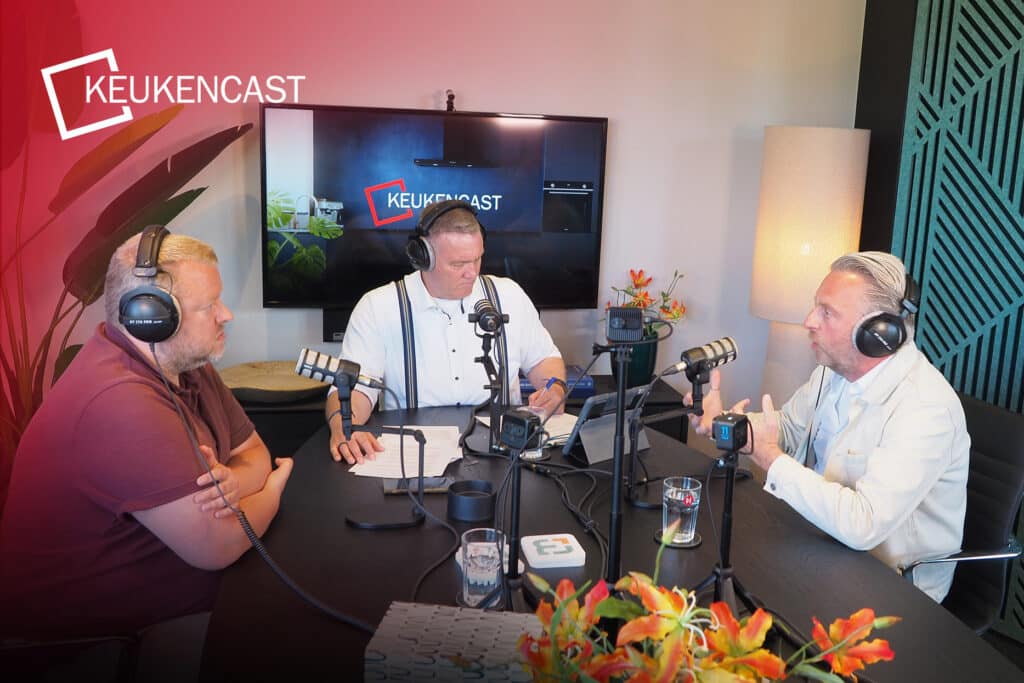
Jerry Helmers: Okay, warm welcome in any case Maarten. But I also say welcome to our guests Roel Oostra and Roger Bor. Warmly welcome. Is this your national podcast debut?
Roel Oostra: Not quite a debut for me, but a debut in Weert, at Louwers Media.
Jerry Helmers: At Louwers Media Group. And Roger, is this your national podcast debut?
Roger Bor: Yeah, I'm all green.
Jerry Helmers: You're all green. I also heard when you guys came in that you had to come along from Roel. We're all going to hear later who you are and what your relationship is to each other and what you do in the kitchen business, but you had to come along, with no idea what's going to happen today.
Roger Bor: Well, I was a little bit informed, but we'll see.
Jerry Helmers: He thought it was way too exciting to come alone. Well we're also going to ask hopefully a lot of surprising questions. Actually nice maybe, Roger, that you don't know exactly what's going to happen at all. Just makes the podcast more exciting.
[01:45] The first propositions
Jerry Helmers: But anyway, again, welcome. We're about to hear more about who you are and what finally brought you here. First of all, I want to present you guys with some statements and then I really just want to know if you agree or disagree with the statement. And who knows, maybe we'll come back to that afterwards in the podcast. Will I submit first to you, Roel, and then to Roger. And then later we'll do vice versa. Because then there will be a little bit of thinking time for the next proposition. All right, Roel, for you the proposition. Consumers have higher expectations of a kitchen store in 2025 than they did ten years ago.
Roel Oostra: Definitely.
Jerry Helmers: Agreed, so you say. Roger, what do you say?
Roger Bor: Yes, agree.
Jerry Helmers: Agreed, then you had to think about it for a while, I believe. Anyway, I'm going to be the first to put the following proposition to you now, Roger. Online orientation is now more important to customers than a visit to the showroom.
Roger Bor: Disagree.
Jerry Helmers: Disagree. And what does Roel say to this?
Roel Oostra: I think that depends on perspective.
Jerry Helmers: No, no, no. Agree or disagree. You want to get into the whole debate right now. But, of course, that's not how a thesis statement works.
Roel Oostra: Then I have the different opinion from Roger.
Jerry Helmers: Oh, this is going to be exciting. We're going to contrast those in a moment. No, I understand. You want to give your explanation right away, but that's not how a statement works. Will things be all right between us?
Roel Oostra: Sorry.
Jerry Helmers: You are indeed sorry. Okay. I have a third proposition for you. Then you again first, Roel. The customer today is much better prepared and better informed than the showroom salesman.
Roel Oostra: Agreed.
Jerry Helmers: Yes, ladies and gentlemen, dear listeners, a silence fell, but Roel agrees. And what does Roger say?
Roger Bor: Disagree.
Jerry Helmers: Disagree. I sense all kinds of fun discussions coming up. But I can see you smiling as well.
Roger Bor: Fancy.
Jerry Helmers: Yes, I see you smiling too. You're looking forward to it. Would you like to comment on any of these statements that you agree or disagree with?
Maarten Zegstroo: I agree or disagree with the second statement.
Jerry Helmers: And the second proposition was: online orientation is now more important to customers than a visit to the showroom. All right, let's get to the content. Guys, guys, gentlemen, are you ready?
Roel Oostra: Bring it on.
[04:04] Roel Oostra introduces himself
Jerry Helmers: All right gentlemen, welcome again. For the people who listen to this podcast - and we know there are quite a lot of them by now - a lot of showrooms, kitchen specialty stores listen to this show. And no doubt listening to this episode as well. Then, of course, it's always important that you introduce yourselves properly. Roel, may I start with you? Who are you? Where are you from? What do you do in the kitchen business? And what brought you here to the studio in Weert?
Roel Oostra: That's a good question. Once in a gray past I studied technical business administration, or so it's called. And worked for big business for a while. And somewhere around my thirties I became very restless. And then I turned left, as I put it myself. My brother Jaap was then a representative for a big German manufacturer, and then I jumped with a store in Hattem. Jaap was of course my prompter, because I didn't understand kitchens at all.
Jerry Helmers: Do you have to know about that?
Roel Oostra: Well, in those days I think the bar was a little lower than it is today. But anyway, back then it worked. And then you could also just play merchant with thirty percent off Siemens. But gradually one business became two, three, four, five. And gradually we grew to brands, the i-KOOK brand was born. Now 28 stores. And KeukenCoach, six stores, a little more in the premium segment.
Roel Oostra: And I'm still happy. I got to reinvent myself a number of times in this profession. And yes, that's important to me, change.
Jerry Helmers: Also for yourself personally, if I hear anything indeed. Keep inventing yourself.
Roel Oostra: Definitely. So this is the trick anyway, to keep the passion.
[05:54] Roger Bor introduces himself
Jerry Helmers: A very good art of keeping the passion. Maarten, we'll have to come back to that later.
Maarten Zegstroo: Yes, I have another question about it in a moment.
Jerry Helmers: Yes, exactly. Roger, who are you? Where did you come from? What are you doing here? And I'm going to ask that other question right away. Because according to Roel, you are the best entrepreneur in the Netherlands in terms of customer experience and giving attention to the customer in the showroom. And I can see you now thinking: did he say all that about me? Yes, he said all that to me in the editorial preliminary interview on the phone. Is it true or false what he said?
Roger Bor: In any case, a nice compliment. Sure. Roger, 45 years old, active in the world for over twenty years. Once started online. At that time I was the only one. Set up a platform, Keukenplaats, KeukensDuitsland.nl. People came to us from all over the country, online, to make an appointment. And those were leads that I could partly handle myself. So people who physically came into the store to buy a kitchen. But I had way too many leads, so luxury problems, and then I started selling those leads.
Roger Bor: And at some point I ran into Roel, who is sitting next to me. With his brother Jaap.
Jerry Helmers: At some point, when was that?
Roger Bor: Say twelve years ago.
Roel Oostra: I think around 2010.
Roger Bor: Yes, a little earlier so. And Roel had physical stores and of course always needed a physical customer in the store. And that's where we found each other. And then Roel said: gosh, don't you feel like opening a physical store yourself? Because I was in Germany at the time and from there my marketing formula got bigger and bigger. Then twelve years ago I started my own physical store in Sittard. And I'm still there.
Jerry Helmers: Are you still sitting there. What difference between Germany and the Netherlands, when you talk about how a sales conversation is conducted, for example, in the kitchen store?
Roger Bor: No, actually not. We were really on that border with Germany, but it was 99 percent Dutch customers.
Jerry Helmers: But doing business in Germany at all? You also have German procurement?
Roger Bor: We did purchase there, but there are not many differences. You just have a different VAT rate. That's the only difference.
[08:08] What makes Roger special in the showroom?
Jerry Helmers: But what do you think about the comment Roel made, that you are the best entrepreneur in the Netherlands in terms of customer experience or in terms of how to pay attention to the customer in the showroom? Because you, as modest as you are, try not to talk about that, those compliments from Roel. But I do want to talk about it.
Roger Bor: It doesn't matter what you're trying to sell. What matters is how you do it, how you package it and how you give attention to the customer.
Jerry Helmers: But how do you do that? Give a concrete tip.
Roger Bor: Yes, it's also my pitfall right away. Always being available. Sunday, Saturday night, customers with WhatsApp questions, you just get them at noon. If you're not asleep then, you just answer them.
Roger Bor: But being real. Really grabbing people by the hand. Even before you've sold a kitchen at all, you go and measure it. You're with the customer in their own environment, familiar. You're not talking about the sale at all. A bond develops with everyone you visit. And at some point that customer can't ignore you. Because you are already so far into the sales process, without the customer even noticing. Then they no longer dare to leave.
Jerry Helmers: Then they don't dare leave, indeed. Roel is going to respond to that right away.
Roel Oostra: What Roger also excels at, I think, is giving attention and that sales process after the sale has already taken place. So at the moment that there are still questions, at the moment that service is involved, at the moment that a difference has to be made somewhere, he feels like: that's the most normal thing in the world. And in that sense I find him, yes, from the beginning it has never been different with him. But of course that is exactly what is expected of us, so to speak.
Jerry Helmers: Right away we're talking about the first topic, of course, that we want to talk about: entrepreneurship in the industry. Maarten, sidekick, what do you think? Should the entrepreneur in the kitchen industry, the kitchen showroom salesman, the owner of the kitchen specialty store always be accessible? As Roger does.
Maarten Zegstroo: It is a USP, I think. I think customers also understand that you're not available 24/7. That's not a problem. I would think it would be good if, nowadays you can also use WhatsApp, for example, to say: we are not available at the moment. That you do that.
Jerry Helmers: But Roger I think answers really substantively.
Maarten Zegstroo: Yes, right. But so he also gains a lot from that. And in the end it's also what Roel says. It's not until the trial with Roger. It's also about what happens afterwards. And if you talk about where good word-of-mouth advertising happens - which is still the best advertising - it's in how you do it.
[11:11] Giving attention to the customer
Jerry Helmers: I think Roel wants to respond to this.
Roel Oostra: Well, in that sense, I totally agree with you. I think there are different ways to best serve customers. And I think what Roger does especially is his way. And that's his authentic way. I think there's a need for that. That it's real, that it's different, that it has a twist. And that can happen in many ways in the process. But that it arises the moment the real energy is released from people.
Maarten Zegstroo: I think if you play it, it doesn't work.
Jerry Helmers: But so if he responds even at 11:30 on Saturday night, so to speak?
Roger Bor: If I'm still awake, yes.
Jerry Helmers: But are you the only one in the kitchen industry who doesn't have a private life?
Roger Bor: I have a very nice private life. I am happily married, for a long time, and I have three children. But anyway, it's a passion. And it's also what Roel says, it's my way how I do it. And that's not necessarily the best way, because it doesn't work for everybody.
Roger Bor: But what I'm not myself, with all due respect, is a supermarket salesman. Who sits behind the cash register and he charges it and he's done. Whatever Maarten says, no, it goes much further. That kitchen you sell, that customer you have, that's your ambassador. That one again sells the next kitchen for you. My phone is, I don't want to say red hot, but it rings regularly. I'm Jantje and I got your phone from Pietje, that's my back neighbor, who says: try to reach Roger, because he can help you.
[13:28] Why attention needs to be better in the showroom
Jerry Helmers: We go to the first topic we want to talk about. Entrepreneurship in the industry. But isn't it also true that in the Netherlands things could be better in the showrooms? Just in terms of attention to the customer?
Roger Bor: Yes, absolutely.
Jerry Helmers: So what's in that?
Roger Bor: The attention you can give to a customer, that could be better.
Jerry Helmers: What exactly do we mean by attention?
Roel Oostra: I think we have to look mainly at the change in the profession. Customers change, the market changes, the dynamics change. And we as an industry have to grow with them. Don't keep thinking: I learned this once, so I do my trick and then it's done. No. You have to keep looking: where can I make more of a difference? This is different for every customer, but the bar just keeps going up.
Maarten Zegstroo: Then what chance do you mean? What is that then? Is it then about higher assessment, better advice?
Roel Oostra: No, I don't see that so much in euros. I see that more in added value. So you have to look for where can I make the difference. I think that's kind of the rat race of retail.
[14:13] As a vendor, do you have to keep growing with it?
Jerry Helmers: But are you talking, for example, about changes, technological changes, that you have to deal with?
Roel Oostra: It can be anything. On the contrary, we have to be very broad-minded about it. We can't see it as something like: we learn this once and then you do your trick and then it's done.
Jerry Helmers: But then do you see a difference in passion between the kitchen showroom salesman who is an employee and the kitchen showroom salesman who is an entrepreneur? Because surely I could also imagine that employee saying, yes, I have passion, but there is a limit somewhere. Otherwise, I'll start my own business. Roger?
Roger Bor: Yes, absolutely.
Jerry Helmers: So how can you demand this of your own people? That they have that same passion that you have. It's a bit of a management challenge.
Roger Bor: Yes, indeed. And that's not my strong point either. I was just talking to Roel about that.
Jerry Helmers: You're not a good manager?
Roger Bor: No, no, no. I don't want to put it that way. Otherwise it would be... Tell. No, yes right. Roel is talking about top sport. I see the profession perhaps too much as top sport, because it is not healthy to be available 24/7. You are an employee in a company and then you also have a private life and then you hope the boss doesn't bother you anymore or a customer.
But Roel is talking about going the extra mile. You will have to do something extra. Especially as a kitchen showroom salesman. In many industries and certainly in the kitchen industry you get a salary and often a commission scheme. And then I think: yes, it's also nice to be able to buy the kids an extra ice cream once. Or you name it. And that intrinsic motivation...
Jerry Helmers: But is that intrinsic motivation there? Because the kitchen showroom salesman works for his commission in order to spoil his children for a day? Or should the passion be precisely in: I really want to sell those customers who come into my store that dream kitchen?
Roger Bor: Yes, I'm charging, of course. You have to be a professional idiot. You have to have fun, you have to enjoy your work. You get up early in the morning and you think: yes, I can do it again, I can go back to work. That has to be your motivation.
And Roel sends through certain turnover lists every week of who has done so much. That's always exciting, of course. But you do it for that too. At least, that's what I do it for. And then I might be an overachiever or a top athlete, but at the end of the day you want that customer to be satisfied from A to Z. And if you look in your mailbox at night and the fitter is done, there's a nice delivery form with zero defects and a clean sheet with nice pictures, then you call the customer. I call every customer a day after installation of: gosh, how did this go, what can we do for you? I visit, we visit the customer with a small present and from there we try to trigger the next customer to visit us again.
[17:41] Work should be more than just making money
Roel Oostra: What I'm looking for ... Look, you can say top sport and use clichés like that. Only, I think what it's about at the core, and that's a development that's obviously in the whole of society, with the labor market as well, as we're sitting here with the four of us... The idea of: I'm working to do a little thing and to earn a few slices of bread, that's no longer how we're going to experience or have to experience work. Because then you're just not going to sell anything at all anymore.
So there's something emotional about that, energy about that and maybe wanting to win, that's also part of it. But it's mainly about: I like what I do. Because it is a wonderful profession, it is a wonderful industry. And it deserves people who are passionate about it every day.
And every day is a top day. But the moment you stop feeling happy and you're doing your thing, then maybe you need to look for something else.
Jerry Helmers: You brought up the concept of a customer whisperer in the pre-conversation on the phone a week before recording this podcast. Yeah, so I'm going to ask Martin here for a moment: what do you think a customer whisperer might be? I think we had a movie once, I believe, The Horse Whisperer.
Maarten Zegstroo: I don't think it's the same thing, but then I also have to be honest that I don't know exactly what that film was about.
Jerry Helmers: But in your opinion, what is a customer whisperer?
Maarten Zegstroo: I think a customer whisperer is, but that's my subjective assumption, that the experiences are shared with each other about how you deal with the customer. That's my how I interpret it now.
Jerry Helmers: Roger?
Roger Bor: It's a nice word. I would interpret it differently. I think, you try during the conversation, the conversations you have with the client, to tell the client something without directly telling them what the end goal is. So you're whispering something to the client, a certain direction.
The client has a certain space and says, I want an island in here. But the space is actually too small. You're not going to say that, because then that customer will walk out and try to buy a kitchen with an island from someone else anyway. But during the conversation you try to change those people's minds by whispering certain things to that customer.
Jerry Helmers: You know what I thought? I thought when I heard the word customer whisperer, and in a moment you'll get the word Roel, that as a kitchen showroom salesman you hear what's not being said. You're impressed with that, aren't you Roel?
Roel Oostra: Yes, very strong.
Jerry Helmers: In your opinion then, which of the three of us was closest? What then is your definition of the customer whisperer?
Roel Oostra: That actually you can never go too far with understanding, deeply understanding what moves your client. That you really understand it. Because in that, and so that runs parallel to making the real difference, you really have to get to know that customer. Do you have to look for the things that are not being said in order to ultimately be the merchant as well.
I think that's really the story of commerce. Twenty years ago, commerce was making and the bar in commerce is going higher and higher. So you don't have to be a psychologist, but you have to be interested. What really moves that customer?
Jerry Helmers: You almost have to be a social worker.
Roel Oostra: Those I think score better in our industry right now. Those who are looking for the deepest motivation. Those score better than those who want to talk about a certain product with all the specifications at all times.
[22:09] Maarten's Minute
Jerry Helmers: Yes, exactly. Another thing that might become cause for tile wisdom is your column. We go to Maarten's Menuutje, the spoken column. Roger, Roel, I don't know what Maarten is going to do with his column either. He's going to read something and usually he also asks a question at the end. So I turn the floor over to Maarten.
Maarten Zegstroo: Does everyone know what KeukenCentrum has been doing from the beginning? Looking at how things can be done differently and trying to market something innovative within that framework. This is how they started i-KOOK in 2001, I look at Roel for a moment, as a counter-reaction to the opaque kitchen world of those days. Their idea: personal attention, honest guidance and no nonsense prices.
By the way, we are noticing more and more in the overall kitchen industry that this did not turn out to be a niche. It is exactly what many people were looking for. And now i-KOOK has 28 branches.
But even in a successful formula, you can notice: hey, the customer is changing. Before starting KeukenCoach, KeukenCentrum heard more and more that consumers come in better prepared these days. They have already scrolled endlessly, watched videos, delved into materials and brands. What they are looking for is no longer basic advice, but someone who really thinks along with them. As a subject matter expert, no longer as a salesperson.
Thus, in my mind, KitchenCoach was born. A formula for the customer who knows what he wants, but also knows that it's in the details. And that requires a different conversation, in a different place, with different expectations.
My question today: do we as an industry still dare to revisit what the customer really wants often enough, or do we secretly still fill it in ourselves too often?
[23:47] Do salespeople still too often fill in what the customer wants themselves?
Jerry Helmers: Thank you Martin for this column. I didn't know what you were going to say ahead of time either, but it ties in almost perfectly with the conversation we ended up having before you started your column. Do we still fill in too much ourselves as salespeople? Roger?
Roger Bor: Yes.
Jerry Helmers: That's a short and sweet answer.
Roger Bor: Yes, indeed. And every now and then you sit at the table with clients and you think: where is it going? And then of course you try to fill it in for the customer. Then when you let go of them, at some point you do get into where they want to go. And then you're surprised by a design, an idea what people have in mind. And they got that from somewhere, from the Internet, from friends, booklets, brochures, you name it.
So indeed listening from time to time. That Roel also says, that kitchen whisperer. Try to listen and sit back and relax. Let the customer answer first. I do agree with Maarten's statement that we often fill in too quickly for the client.
Maarten Zegstroo: By the way, do you notice that different customers come in? Customers who are very introduced and customers who really bought their last kitchen 12 years ago and don't really know what to expect? How do you actually deal with that? Because how do you find out?
Roger Bor: When you come in, you already see, some have a whole booklet with drawings and numbers, you name it. Others just say: I was here twelve years ago, I want a new kitchen again.
Maarten Zegstroo: In fact, it also seems to me to be incredibly difficult. Because even imported customers who come over are generally not completely introduced. That could also be a coat they have put on, because they find it interesting or think: I keep a grip on the conversation. But ultimately it's the retailer with the real know-how, we assume for a moment. Because this is what we talk about every podcast. There are also a lot of really good retailers out there.
But it seems incredibly difficult to test myself: does that customer really know everything? Because they are also going to tell you what they want, but sometimes much more than what they want is possible. They may not know that AI cooking exists.
Roger Bor: That's what we're here for.
What we notice, for example people who come with an architect or who have been whispered in by an architect, that is often very beautiful what they show. But we are the people who know about kitchens and they can then tell you: what is sketched by that architect, that is possible, but then you will already have to take into account certain items, technical items for example. An extraction. You will have to make a hole somewhere to the outside or work with filters, you name it. We are the people who know about that and have to point that out to them.
[27:53] Time pressure in the sales process
Roel Oostra: What can chafe a little bit there sometimes also, is that of course you are different from Roger's clients, maybe because there a network also plays a role there, but that for random clients... The best thing is, then time is also under pressure. We don't get paid for the advice, we get paid for the kitchen. So that's kind of a weird...
Jerry Helmers: You don't get paid for the advice. But you do get paid for the kitchen.
Roel Oostra: No, but that's part of the working model. That you just end up delivering a kitchen with a bit of a margin from which the chimney then has to smoke.
Jerry Helmers: But that kitchen ended up, or that purchase also came about based on the quality of the advice.
Roel Oostra: Yes, but that's not my point. The point is that we often fill it in, I'll come back to that from Maarten, but that's also because we're under time pressure. We are in a kind of model of: well, we do an intake of half an hour and then the client comes back and then we are going to do a counseling session for two and a half hours. But then there's already pressure and then of course at some point you kind of want to know. What's going to happen? Because you're not going to do three months of consulting. And we just have to deal with that as an industry. That might also change, but I think that's what goes with that proposition.
Roger Bor: Well, I don't quite agree with that, Roel, sorry.
Jerry Helmers: Come on.
Roger Bor: Well, very often I have customers who come back to the store five, six times. That's a three-, four-month process. I have customers who spend a year picking out the kitchen.
Invest. And that's what I said in the beginning. I do think that the difference I try to make myself in that is that you also keep those clients by the hand and give them the confidence: stay with me, it's going to be okay.
Sending the occasional app: can I be of service with something? That's a very different sale than a half-hour intake and then a two-and-a-half-hour sales call and then he has to be on it.
Maarten Zegstroo: So which customer are you referring to? Because it seems to me there's also a difference in whether you're talking about a kitchen of 8,000 euros or 40,000 euros. That you say: well, for 40,000 euros I'll take longer. What about you then, Roel?
Roel Oostra: I think you have to think in all kinds of shades of gray. I think Roger is a customer whisperer, out of category. What he is doing, what he has managed to do over the last twenty years, that is exceptional. He has a network, all customers talking to each other, all saying: you have to buy from Roger. And the moment such a customer, such a lead reports to Roger, he already knows that he is going to sell it. So with him there is also less pressure, because he has worked so hard for that.
But that, of course, is also built from experience.
Maarten Zegstroo: But it's sometimes very difficult for consumers to find the right retailer for their right feel and budget and wallet. So we could actually help them with that as well. Because there are things that we all know that when you walk in there, you walk in at the mid-high end. But when my parents walk in there and they look at the prices, they think: I don't need a new kitchen for the time being. Whereas there are also kitchen stores that can just treat them well and answer their questions. So I think that's something the industry can do something with, I think. And that's still quite a challenge.
Roel Oostra: When you're on autopilot, talking about products is always safer. But customers want to know who you are. They want to see you. That's what it's all about. And that's the key of course today also to distinctiveness in retail.
Because the factories always want us to tell a story. That's fine from their perspective, but it doesn't allow us to differentiate ourselves. We have to understand that as retailers.
[34:46] What can the kitchen industry learn from other retail industries?
Jerry Helmers: Before we go to your final two minutes, I want to talk a little bit about Inretail. Roel, you're on the membership council there. You represent the kitchen industry there. Tell me briefly what you do there in that membership council. And that's always a question I ask people who are in advocacy: what can we judge you on a year from now?
Roel Oostra: You can't judge me on anything. The membership council actually represents the members, so for controlling the direction of the association. It's about the future of the whole retail sector. And what's interesting there is that within retail you have a lot of different industries. Within retail you have all kinds of sectors and they're more or less all facing the same challenges.
But one industry is more advanced in one thing and another is more advanced in another due to specific market conditions. So by putting your heads together you can learn a lot from each other.
Jerry Helmers: Give an example. What can the kitchen industry learn from another industry?
Roel Oostra: The kitchen industry is very emotional. The product is often customized. But there are other industries that are already much further along in digitalization of processes, for example. And digitization is also a way for the kitchen industry to allow entrepreneurs like Roger Bor to survive. Because they really only have to deal with customers. And the rest is really all secondary.
Jerry Helmers: Are you talking about digitalization in customer contact and marketing?
Roel Oostra: Yes, data, for example.
Jerry Helmers: Do you work a lot with data, Roger? Or is it still mostly fingerspitzengefühl?
Roger Bor: For me, yes. But then again, who am I? I do it my way and that's authentic and that works for me. That doesn't mean that works for everyone industry-wide.
Roel Oostra: And he's out of category, so that's it too. We always have to see that. That's not the average entrepreneur, let alone employee.
Jerry Helmers: But you're not going to succeed in answering the question of what we can judge you on a year from now?
Roel Oostra: No, I wouldn't know. Doing good monitoring. I hope to pick up some inspiration here and there from other member council members or board members to ultimately move the image and the kitchen industry forward. That's what I stand for.
Jerry Helmers: Good, then we'll talk about that another next podcast. Have we really moved forward in the kitchen industry?
[37:58] Concluding remarks by Roel Oostra
Jerry Helmers: What we're going to do now is listen to your two minutes of free speech, as we call it. You're totally allowed to say whatever you want to say. You may come back to something that was discussed in the podcast that you may finally know the answer to. Whatever you want. Are you ready? Because I believe you're going to do it right, Roel?
Roel Oostra: I'm going to do it.
Jerry Helmers: You're going to talk all the way through those two minutes. Maarten and Nick keep our mouths shut. Or Maarten are we going to interrupt nicely faintly, aren't we?
Maarten Zegstroo: No huh.
Jerry Helmers: We can always hit the emergency button. Are you ready for your two minutes?
Roel Oostra: Definitely.
Roel Oostra: The kitchen industry offers great opportunities and challenges. Customers expect more than ever: personal advice, craftsmanship, speed, service, et cetera. Economically, we have to deal with pressure on margins, scarcity of professionals, need for professional training, digitalization, and laws and regulations.
In short, we are experiencing the pressure to work smarter and more efficiently. And then social impact. We no longer can or want to simply make money and make our customers happy. We entrepreneurs are expected to do more than that. We will have to become socially relevant, especially with the power of local entrepreneurship.
Future-proof business requires that we move ever faster and in harmony with customer value, economic value and social value. In other words, everything in harmony. It is virtually impossible to do everything on your own. We can't all be simultaneous switches, right?
And The Hague? The Hague is not going to help us, I don't think. That's why franchise is more topical than ever. Or cooperation. A good concept like i-KOOK or KeukenCoach - but there are many more - offers structure, support and scale without losing the freedom of entrepreneurship.
It enables entrepreneurs to grow together, innovate together and deliver value together. For customer, chain and society. One plus one plus one is five: synergy. Franchise is the future, because the business is ours, but we are not the business. Entrepreneurship and a committed private life go well together. He sits here next to me.
I wish all potential entrepreneurs in kitchen land much cooperation and a great formula.
[40:18] Reflection on the argument
Jerry Helmers: Thank you Roel. All but nine seconds neatly filled two minutes. I'm going to take a look at Maarten. What did you think of this speech? You ask a question in Maarten's Minute to our guests, but I'm going to ask it to you now. What did you think of this closing speech by Roel?
Maarten Zegstroo: I heard that the first paragraph was about the same as my paragraph. It was similar to each other. Other than that, I completely agree. It's a beautiful utopia to work toward together.
I think it's such a shame that the image of the industry deserves much more than what we have now to the outside world. And we often discuss that here as well. We all have to work hard for that. Because we all deserve it too.
[41:25] Closing the episode
Jerry Helmers: Very nicely said Martin, thank you. I look at Roel and Roger. What did you guys think of this podcast? Because we're going to proclaim now. Was this a happy moment of the day?
Roel Oostra: I thought it was super fun and I'm glad Roger came along.
Jerry Helmers: I thought it was a surprising turn of your week Roger when Roel asked you.
Roger Bor: Yes, very nice. Roel asked me last week or two weeks ago. That was fun. Also nice to see that Roel looks from a different lens, literally, than I do. I look a very small world, my own world. And Roel obviously draws much wider. The truth will be floating around somewhere in the universe. But for me it was a very nice afternoon here.
Jerry Helmers: See, that's good. So we're going to see you guys again sometime. In which we're going to ask even more questions of each other and have even more discussions with each other. Thank you very much for coming.
Roger Bor: You're welcome.
Roel Oostra: You're welcome.
Jerry Helmers: Dear listeners, you have been listening to KeukenCast, the podcast for trade professionals with ambition in the kitchen industry. My name is Jerry Helmers and I was your host and presenter.
Thanks again to our regular sidekick, kitchen guru and kitchen expert Maarten Zegstroo.
Dear listener, if you too would like to drop by KitchenCast, you're welcome. Check www.keukenbouw-online.nl.
Engineering: Daan Holtus and Mark Schouten. Project manager: Folkert van der Werf. Final editing of our magazine is, as always, in the hands of Suzanne Peek.
KeukenCast is a production of Louwers Mediagroep in Weert. Until the next episode. Until the next KeukenCast.