Transcript
[00:00] Introduction of the episode
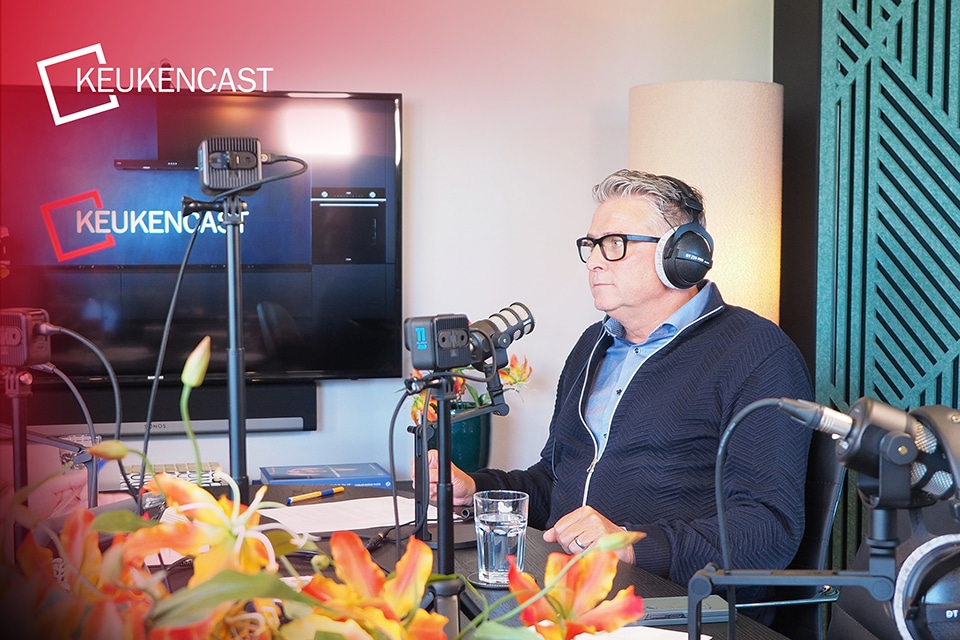
Jerry Helmers: This is KeukenCast, the podcast for trade professionals with ambition in the kitchen industry. In each episode, an expert sits down to discuss the most important trends, themes and developments. Of course, we don't shy away from a discussion either, because we sit at the kitchen table. And sometimes on the kitchen table and also under the kitchen table. We do it all. My name is Jerry Helmers, I'll be your host and presenter. Please welcome.
[00:40] First encounter with Maik Idzes
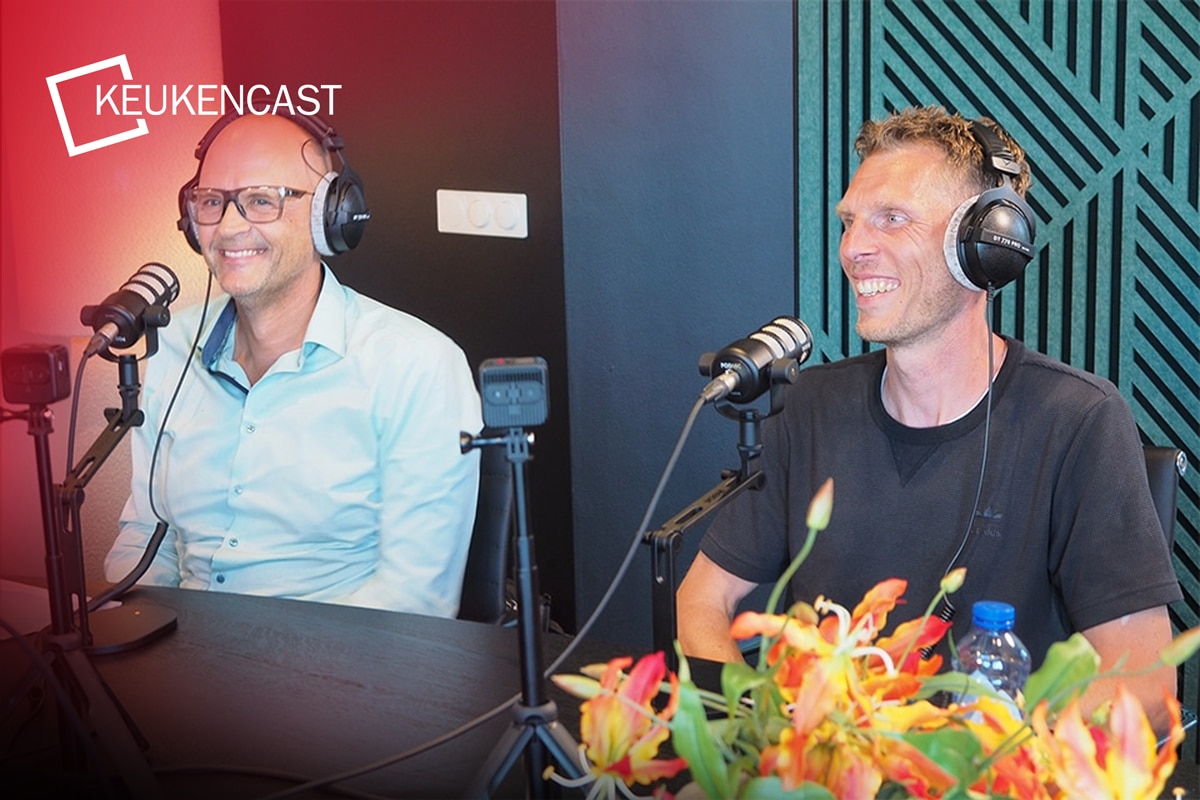
Jerry Helmers: And in this episode of KitchenCast, I've lost count for a moment of how many episodes we've made, but this is the first episode where Maik Idzes has joined us from Cora Techniek. Welcome Maik, are you looking forward to it?
Maik Idzes: Yeah, sure, I'm curious.
Jerry Helmers: Yes, we're going to introduce you a little bit more in a moment. I want to present the agree-and-disagree questions to you later on, but at the same time I'm looking to my right, because there sits Maarten Zegstro, kitchen guru, kitchen expert, well, whatever fancy names we can come up with for you. But you in all those nine times, you've seen immediate answer to that question, and episode 9 already.
Maarten Zegstroo: That's how it is.
Jerry Helmers: Well, then I'm up to speed in that regard as well. Maarten, you're going to be my sidekick again as you have been in all the previous eight episodes. Yes, you're just going to get involved in the conversation from time to time. Well, of course I have to wholeheartedly accept that. But also in the middle of this podcast you again have Maarten's Minute, in which you're going to read your column.
Maarten Zegstroo: Yes, that's right.
Jerry Helmers: Yeah, and I don't know at all what you're going to do. So Maik and I, we both have to be on edge, because we then have to start responding to his column.
[01:32] Disagreements and disagreements
Jerry Helmers: Are we ready for the agree-and-disagree positions, Maik?
Maik Idzes: Well, let's do it.
Jerry Helmers: Well, here they come. You're really only allowed to say agree or disagree. Coming up. The very first one. Solid Surface is the future of countertops in the kitchen industry. Agree or disagree?
Maik Idzes: Agreed.
Jerry Helmers: Agreed; I didn't really expect it to be any different either. But we'll hear about that in a minute, what material you work with a lot. Anyhow, comes proposition two. Solid Surface can compete in durability with other countertop materials.
Maik Idzes: Agreed.
Jerry Helmers: Agreed, well, then I hope the third proposition is a little more difficult, which you might have to think about a little longer, just to keep it a little bit exciting. That proposition is: there should be a legal requirement for kitchen retailers, in cooperation with the manufacturers, that logistical processes be put in place to recover materials after use.
Maik Idzes: Disagree.
Jerry Helmers: Disagree. Maarten, what's your take on that last statement?
Maarten Zegstroo: That last one? I do agree.
Jerry Helmers: Are you ever?
Maarten Zegstroo: Yes, I do agree.
Jerry Helmers: The Future. Okay, no doubt we'll talk about that later then.
Maik Idzes: Gladly.
[02:40] Who is Maik Idzes?
Jerry Helmers: But first we're going to listen to Maik. Who he is, where he comes from, what he does, what brought him here to the studio and what is his unparalleled kitchen expertise. Maik, once again welcome to the studio. Who are you?
Maik Idzes: Well, thank you, thank you for the announcement. I am Maik Idzes, 35 years old, happily married since one year, father of two beautiful children, living and working in the very hospitable Asten.
Jerry Helmers: We hear that a little bit from that soft G.
Maik Idzes: Yes, half an hour away, a soft G. I try to disguise it, but I don't think that's going to work. So I just keep being myself. I am commercial director and co-owner of our beautiful family business Cora Techniek. We are a specialist in the processing of Solid Surface, in the broadest sense of the word. I'm at the helm of the commercial side.
Jerry Helmers: How big are you guys? How many people work for you guys?
Maik Idzes: Currently 22.
Jerry Helmers: 22?
Maik Idzes: 22 people, some self-employed, mostly in assembly. So by now a nice young club.
[03:59] Second generation in the family business
Jerry Helmers: It's a family business, right?
Maik Idzes: Yes.
Jerry Helmers: If I have read up correctly, you are the second generation.
Maik Idzes: Second generation.
Jerry Helmers: Second generation. And what prompted you, as the second generation, to join the company in running it and not find another nice job?
Maik Idzes: Well, I would tell you honestly that I first started working somewhere else because I first wanted to see what the business world is like.
Jerry Helmers: Yes, you might have had to do that from the first generation as well.
Maik Idzes: The first generation, my father is, he never pushed me. I did always participate in the company. So I used to work in production. So I'm also a guy who just puts his feet in the mud. And just tries. Then I got a commercial education. And then at some point I saw so many opportunities within the Solid Surface market that I thought: that's where I have to step in.
[04:51] The team's message
Jerry Helmers: Before we get to the content, because we agreed in advance that we were going to discuss three topics, I'm curious. You say you have 22 employees. You drove away on the job this morning, 22 employees, waved you off. But what kind of assignment did they give you? That you say of: Maik, you're on the most famous podcast in the kitchen world this afternoon, you slide in there. You have to say that anyway.
Maik Idzes: We don't make enough kitchen countertops these days. I think that's the biggest message.
Jerry Helmers: We don't make enough kitchen countertops these days. Okay, well then we'll think about it. Maarten, do you want to think about...
Maarten Zegstroo: Well, I have to confess very thickly that even though I have been a trade editor for 15 years and am considered a kitchen guru by some people, I had to dig very deep if I knew what Cora was, so to speak. What the company was. I didn't know it very well. So I'm also actually curious of: can that be right? And if so, how come?
Jerry Helmers: Well, Maik, sell yourself.
[05:58] What is Solid Surface?
Maik Idzes: Yes, well, I will initially then try to sell the product of course. I'll start first with a brief introduction of what Solid Surface is. Because I don't think every listener knows exactly what it is. No doubt they have heard of it and have come into frequent contact with it in public buildings, restrooms, as well as reputable commercial businesses, retail, you name it. Solid Surface is a material composed of a mix of natural minerals and synthetic resins, such as acrylic and pigments. Pigment mainly to create the color. It is known for its versatility. It is not porous. I think the most important feature is that you can glue it seamlessly. So we can literally put two sheets together, put glue between them, let it cure, polish it, and then you really have one sheet instead of two. Yes, and I think that's really the unique feature of Solid Surface, which also makes it repairable. I'll come back to that a little bit later. A little less known to the kitchen world is that it's also thermally deformable. So we can bend the material under heat. If you look at the contemporary style, kind of the Japandi style for example, you see a lot of round fronts in there and round countertops.
[07:19] An underserved child in the worksheet world
Jerry Helmers: Solid Surface is not known to everyone. I feel like it's been a bit of an underdog in recent years. Is that the right expression? Understudied, snowed under in the whole worktop world. Let me put it this way. Or turn it around. I feel like it's becoming more well-known in recent years.
Maik Idzes: When I look at my father, who founded the company, he actually started out being a countertop manufacturer for kitchen stores. In the earlier period, he actually did it no differently. I joined that about 10 years ago. Then I really saw opportunities there as well. So I first started looking at how can you actually facilitate the kitchen world a little bit more? How can you get those kitchen salesmen to start selling Solid Surface? Because there was a lack of awareness there. Then I discovered very quickly that it takes a lot more than just bringing in a few samples. So yes, in the beginning we really started to struggle with: okay, how can we make sure that the whole infrastructure of sampling, plates in stock, calculation modules, price lists, sales managers or sales people who give training and so on, how can we facilitate that as well as possible? Well, then I really did see a boost in our sales.
Jerry Helmers: Because they got excited?
Maik Idzes: Yes indeed. It doesn't take super much for me to enthuse someone with Solid Surface. I would almost say it runs through my veins. But people also see the advantage. I have to add that sales people have to understand the product if they want to sell it well.
[08:59] Vendors need to understand the product
Jerry Helmers: Ultimately, you need quite a bit of technical knowledge for that. You mentioned that in your introduction later. For those listeners who may also have never heard of Solid Surface, or don't know exactly what it is, there are quite a lot of USPs to it, I would say. But you just have to know it all. Yeah, right. Because how do you also get, and you say then you go and give training sessions, or then you visit those kitchen stores, how do you do that?
Maik Idzes: Yes, we have even gone so far in the past that we simply train kitchen fitters from reputable kitchen stores to be able to install and glue the material themselves on site. So that we really are the supplier, we supply the worktop and the kitchen store installs and glues it themselves. So also very much thinking along in how can we together give that market more Solid Surface. And actually a little bit that side of the story. You say indeed the revival, so I do agree with you. If you look at the countertop industry, we've had some setbacks since the pandemic, for example. When that whole chain and that whole infrastructure kind of falls away because of uncertainties, it's also much harder for a vendor to sell.
Jerry Helmers: What do you mean when the chain breaks down because of ambiguities? What do you mean by that?
Maik Idzes: Well, we were very much faced with plates that were out of stock, collection changes, price increases, really up to the max. Which at a certain point made the kitchen salesman a bit reluctant. And who then often grabs, I think, and this is a bit of an opinion I'm giving now, but who then often grabs to the familiar. The path of least resistance. I'm fine with my calculation, so I prefer to sell that.
[10:41] What is the USP with a smaller kitchen?
Maarten Zegstroo: Yes, because then where is the USP? You explain your USPs, right. So round shapes, very large surfaces. But a little kitchen of four by three, where is the USP of Solid Surface?
Maik Idzes: The material is repairable anyway. It gives it durability. So if you ever get damage, we can really just restore it like it's like new again. It's super user-friendly. Maintenance-wise, it's really just a wipe over it and the dirt is gone. Nothing soaks in, so it's not porous. We also apply it in laboratories, for example, in health care. Well, when I tell that story to salespeople, it provides a kind of assurance. Then they also think: but what about health care?
Jerry Helmers: So then you also have about hygiene.
Maik Idzes: Definitely.
Jerry Helmers: Yeah, okay. Maarten, are you getting excited about Solid Surface?
Maarten Zegstroo: Well, what I'm always curious about is of: how would you now, from your organization, in a nutshell, want a retailer to explain to a customer why they should choose Solid Surface?
Jerry Helmers: Good question.
[11:55] How do you explain Solid Surface to the customer?
Maik Idzes: I always take the most talked-about advantages of the material. So I always explain that the seamless properties of the material, people pretty often understand those right away. So I would initially say, well, it's a cuddly friendly product, super low maintenance and it's seamless, so you don't have seams anywhere. So even with solidified walls, it runs as one piece seamlessly. If you have a corner sheet, you don't have a sealed seam, you just have a tight one-piece. Really a seamless aspect, that's one of the first things I always bring up though.
Maarten Zegstroo: Yes, but of course it can also be, because that also happens in the industry I think, that it comes from the retailer's advice and not so much to explain it to the customer. They understand, I mean, because it could also be that you say: just use it now and suggest it to the customers to take this worksheet, because the retailer knows what benefits are.
Maik Idzes: There is that possibility, of course, yes, right. The other side also happens a lot. Customers who themselves also say to the retailer: well, I really just want Solid Surface again, because I've had it for ten years and I'm satisfied with it.
[13:08] Creating consumer demand
Jerry Helmers: But then do you also, do you also try to get bottom-up communication and marketing going? Because I understand that as a supplier, manufacturer of Solid Surface countertops, of course you direct your communication to the retailers of, very flatly, you can also sell this. But of course how cool is it when consumers themselves step in. Do you do anything in that regard?
Maik Idzes: Yes, definitely.
Jerry Helmers: So how do you do that?
Maik Idzes: From my commercial background, I really learned the push-pull techniques of course. So I definitely took a two-pronged approach to that strategy. Apart from trying to be in a trade magazine once in a while, we really did use social media a lot. If you see a picture of our kitchen, it's often high-end, but it's also often eye-catching. So where I've benefited a lot in the past is very simply on Pinterest, for example. At one point on certain kitchens just 40,000 views. Then at some point you get a lot of inquiries, just in the Netherlands or Belgium, of that product. And then if there are very few good quality processors, then there is a kind of funnel to us and then the phone call goes out one day.
[13:08] Creating consumer demand
Jerry Helmers: But then do you also, do you also try to get bottom-up communication and marketing going? Because I understand that as a supplier, manufacturer of Solid Surface countertops, that of course you direct your communication to the retailers of, very flatly: you can also sell this. But of course, how cool is it when consumers themselves step in. Do you do anything in that?
Maik Idzes: Yes, definitely.
Jerry Helmers: So how do you do that?
Maik Idzes: From my commercial background, I really learned the push-pull techniques of course. So I definitely took a two-pronged approach to that strategy. Apart from trying to be in a trade magazine once in a while, we really did use social media a lot. If you see a picture of our kitchen, it's often high-end, but it's also often eye-catching. So where I've benefited a lot in the past is very simply on Pinterest, for example. At one point on certain kitchens just 40,000 views. Then at some point you get a lot of inquiries, just in the Netherlands or Belgium, of that product. And then if there are very few good quality processors, then there is a kind of funnel to us and then the phone call goes out one day.
[14:14] Sustainability as a strong feature
Jerry Helmers: Sustainability is actually also a topic. I haven't actually heard you talk about that because, of course, we discussed the action proposition and you said you agreed with that. Solid Surface can compete in durability with other countertop materials. I would almost say that is also a unique selling point nowadays, because every product just has to be sustainable. At least, that's what society thinks, that's what consumers think. Indeed, what about Solid Surface actually then? Because you agreed with the statement.
Maik Idzes: Yes, definitely, definitely. Well, there are basically anyway some sheets and some colors that contain recycled content. So there are just out of 100 colors, for example, there are about 20, 25 that contain 20 or 25 percent recycled content, so they have a sustainability certification, which is also important for architects, already. Then I do come back to the restorable piece. When I look at the repairability of the material and how often we still completely refurbish a kitchen after 10 or 15 years after a service, and then that customer says, wow, I just have a new countertop again after 10, 15 years. Well, then I think that might be the best durability feature of the material.
[15:31] Should materials be subject to mandatory recall?
Jerry Helmers: But you disagreed with that proposition. It was a long proposition, I'll mention it again. There should be a legal requirement for kitchen specialty stores in cooperation with the manufacturers, that logistics processes be set up to recover materials after use. Surely there is a good obligation in that, if you would agree with that, to achieve those sustainability ambitions. But you disagreed with that statement.
Maik Idzes: Yes, if I'm very honest, I also see a bit of the hassle that goes with that. It's not easy to recover used materials. If I look at us, we also sometimes just reuse kitchens that we installed. We take those back or we put those in the pantry. The leftover material from kitchens that we once made, we actually always use up all the way down to the last plate, because we can glue all those plates and all those pieces back together.
Jerry Helmers: But then, do you yourselves at Cora Techniek have a logistics system or a logistical idea to indeed retrieve that material, so you don't need a legal requirement?
Maik Idzes: No, look, suppliers are trying to make it a bit cradle to cradle. So really from the supplier's point of view: well, how much waste do you have in a year? Can I collect that waste and make a new plate from it? Those techniques are certainly working in the background. There is no legal obligation.
[16:57] Plea for obligation
Jerry Helmers: You agreed with that, Martin. You agreed with that statement. You do think there should be a legal requirement. Well, convince your interlocutor across this podcast table.
Maarten Zegstroo: No, I think that's where we're headed.
Jerry Helmers: But that's something else.
Maarten Zegstroo: But I think that the obligation will ensure that we go there. And otherwise I think it's going to be a very difficult story that companies are going to do that by themselves, because so indeed there's going to be such a hassle. So I think if we want to bring this about, it will have to be accompanied by the obligation.
Jerry Helmers: But yes, if companies are going to do this on their own, then they are organizing efficient red tape themselves, right? Isn't it the case, what Maik says, that if you impose a legal obligation, that precisely then you do indeed get bureaucratic hassles? Papers to fill out, reports to keep? Yes, that is quite an issue.
Maarten Zegstroo: You certainly have a point. I do. I just think it's a pipe dream that all companies are going to do this on their own. That's why I think that obligation is necessary to bring it about.
Jerry Helmers: Well, so there you are not. Maik, go against it.
Maik Idzes: Maybe you could say that companies could make it mandatory for a certain percentage. Just to see if it works. Indeed, what I mean by red tape is also unnecessary mileage driving, which makes the sustainability story sound nice on the front end, but doesn't actually accomplish anything on the back end.
Jerry Helmers: Yes, then we keep greenwashing huh. Of course it's also a PR tool, sustainability. We also have to...
Maarten Zegstroo: A bit careful that sustainability is of course going to become a catch-all term for half USPs, or not even a USP anymore. Let's put it this way.
Jerry Helmers: So it's become a bit of a fashion term.
Maarten Zegstroo: Definitely. It's also kind of easily used everywhere.
Jerry Helmers: Sustainability, sustainability, and you have your PR strategy in order, I would almost say.
[18:46] Is Solid Surface the future?
Jerry Helmers: Anyway, Solid Surface, a revival. One of those statements was also, Solid Surface is the future of countertops in the kitchen industry. I totally get, Maik, that you say once. But prove you're right when you say once.
Maik Idzes: I didn't feel I could say I would disagree.
Jerry Helmers: No, you would have had problems with those 22 employees who waved you off on the way to the studio this morning.
Maik Idzes: No, exactly. Look, I do believe that there is no perfect product. So I'm of the opinion that you have to look at where the customer's need is and for that specific customer, that for that Solid Surface is really the best product. That's my opinion.
Jerry Helmers: You did a good job of working your way out.
Maik Idzes: No, well done.
Jerry Helmers: Nice answer.
[19:36] Maarten's Minute
Jerry Helmers: We're going to take a break. At least, the break, that would suggest we can pause, but we don't. Because in that break we are going to listen to Maarten's Minute, to his spoken column. Maik, I also ask you to pay attention, because usually this columnist, this sidekick, ends with a question at the end of his column and you get to answer it. Maarten, Maarten's Minute, are you ready?
Maarten Zegstroo: Definitely. Go figure. You're a sales consultant or retailer and you have to sell a kitchen. The customer expects the best tailored advice, stylish and future-proof. At the same time, the market is moving, maybe not at lightning speed, but every day. New materials, additional structures, subtle color nuances, matte finishes, combinations with wood or stone. And everything has to fit into one design. Cora Techniek, they supply Solid Surface materials and specialize in customization. That means endless options. Think marble looks, terrazzo effects and the like. Beautiful all of course, but how do you explain that convincingly and understandably in one conversation? Kitchen consultants, meanwhile, need to be walking Wikipedia pages on kitchens. Especially with consumers reportedly stepping in more and more informed. Fortunately, there are more and more tools to help customers choose. Large samples, digital configurators, 3D renders, they all provide some guidance. Still, it remains human work: listening, translating, advising. Because in the end, the material not only has to be beautiful, but it also has to match the use and desire of the customer. The question for Maik is: do we actually see enough how complex and professional the profession of salesman or retailer has become? Or do we all sometimes underestimate it a bit?
[21:35] The knowledge pressure on the kitchen salesman
Jerry Helmers: Thank you Martin for your column. I actually had to laugh a little bit when I heard your column, because I always have a list of statements like that before we start the podcast. And I also had a proposition, I ended up not putting it to you, Maik, at the beginning. The statement was: showroom salespeople often don't know enough about the properties and limitations of Solid Surface. Well, that ties in a bit with Maarten's column. Anyway Maik, what do you think about that? Has it often sometimes become too complex to tell a decent story in the kitchen store, in the showroom?
Maik Idzes: Yeah, I think it's underestimated how much kitchen salespeople need to know. Yes, definitely. So I look at the average kitchen salesman and what's involved, that they have to have specialist knowledge of cooktops, ovens, you name it, apart from the materialization of... Wikipedia page, I think that's a really good description there. I think they really have to be incredibly knowledgeable about a lot of things. That's underestimated.
Jerry Helmers: But you then also have to compete with your knowledge otherwise with all these other countertop manufacturers, appliance manufacturers. So how do you find that?
Maik Idzes: Well well, I never try to convince another person by making a better argument than someone else. I listen very much to the need. So I also listen to the customer and I listen like: what does this customer really need and what does it actually rely on and what is it looking for? And if I then hear: okay, I want a long worktop and I want to go beyond certain dimensions and I think use and maintenance are important and I'm allergic to seams, yes, then I'll head it right in.
[23:23] Communicating three clear USPs
Maarten Zegstroo: Yes, but I think, he also now mentions the three, in my feeling as yet, of knowing. We're talking about them now. He also mentions three very specific, important USPs of the product. And we've talked about this before as well. A lot of technical knowledge is expected, but maybe sometimes it's good to support and help of what are those three dots that are very important to promote the product, in this case then Solid Surface, or another countertop. So I think sometimes it's impractical, because as soon as somebody does know everything... Because we're talking about: an employee doesn't know everything, and then again a retailer or the owner is responsible for how that employee behaves. But not every employee can have as much knowledge that some consumers do need.
Jerry Helmers: So what would be the solution if all that information is a lot, from Wikipedia pages, and it's all too complex? How do we solve that to still keep consumers well informed?
Maik Idzes: Look, I always tell the kitchen salesmen: try to have a good basic understanding of what we sell. That's why we train them. But if it gets too complex or you get difficult questions, you have to be honest about that too. Then I wouldn't tell a story. Then I would just say: well, I have a perfect partner for that, so specialist, do you want to come through or go to another processor? There you can see it with your own eyes what the material does and what the material is. I find that consumers are also willing to drive a few miles for that because it's quite an investment.
Maarten Zegstroo: Yes, which they engage in. Does such a kitchen wiki, which exists, also work for an employee?
Maik Idzes: Well, then again you get the basics of course.
Maarten Zegstroo: Yes, that's the problem.
Maik Idzes: When I look at the salespeople who have been with us, they always come in skeptical and they always walk out whistling. They say: wow, I learned so much from this. So it's also really tasting and feeling rather than just gaining knowledge. With knowledge only reading, where you have no experience.
[26:13] The interior designer as a competitor
Jerry Helmers: Then we have the bridge to the next topic. Because that kitchen specialty store has to somehow make sure that there is enough knowledge in house to tell that story to the consumer as well as possible. But we also see in recent years a tendency for the interior designer to become a competitor of that kitchen specialist. Maik, how do you view that? Does the interior builder have that knowledge in house, so that they are actually becoming a competitor of the kitchen specialist in that area - knowledge transfer - as well?
Maik Idzes: Yes, also definitely. If we look at our sales and sales, interior design really did increase. Also on countertops compared to the kitchen business.
Jerry Helmers: So where does that come from? All of a sudden this interior designer interfering with our craft.
Maik Idzes: Yes, well is also a... No look, I think an interior builder rather chooses to have fixed partners. And also honestly say: we can offer everything, but for this I have this partner, for this I have this partner, for this I have this partner. So that's more working in networks. So an architect is very good at inventing and the interior designer is very good at bringing everything together.
Jerry Helmers: Yes, but what do you mean by bringing everything together? Because what I don't hear - and what I might have expected you to answer - is that also the kitchen has become part of the living room. Or the living room has become part of the kitchen. It's just how you look at it. Which makes people, consumers who are in that specialty store looking for a kitchen, immediately have to think about the rest of their home. And vice versa. Is that another reason why the interior designer is playing a bigger role?
Maik Idzes: Yes indeed. See, that interior designer is immediately responsible for the whole house afterwards. So the bedroom closet and the dresser closet.
Jerry Helmers: It should all fit together, it should kind of fit. But so is there a risk there for the kitchen retailer?
Maik Idzes: There is a risk there, yes.
Jerry Helmers: How do you see that, Martin? Because of course it's already a problem: having all that knowledge in house is quite complex. How are you going to tell them? They actually have to have even more knowledge of the rest of the house.
Maarten Zegstroo: Looking at myself as a consumer, I favor preferably one point of contact for a project. But I also see kitchen retailers who are starting to do more and more things in addition. So who are going to sell floors and who can also sell an intermediate cabinet. So you do see a shift there as well. That's different from an interior builder, of course. So I think there have been intersections anyway. And in my sense, that has been given an extra push by the open kitchens. I do agree with that.
Jerry Helmers: How do you see that yourself, Maik? In a few years the market will have completely changed?
Maik Idzes: No, I don't think so. I think it will continue on this footing for a bit. But I do think it's important for the kitchen stores to find certain permanent partners, also in a piece of customization. So that they can combine that standard cabinetry with just the customization that the consumer demands. Especially in the higher segment.
Jerry Helmers: But then also do you say: the link is made with the living room? With the furniture in the living room?
Maik Idzes: Yes, I think so. I think they will go a little bit further soon. So the kitchen experience now is also quite an atmospheric experience. So kitchen salesmen also try to convey a feeling. So the whole setting.
[29:45] What is ‘experience’ in the showroom?
Jerry Helmers: Just a side note. We've recorded podcasts before, of course, and often talked about the concept of experience. Just what is your definition of experience? I advise listeners to listen back to another episode where we talked very extensively about the concept of experience. But what is your definition of experience?
Maik Idzes: Well, if you get a certain feeling about something - and hopefully that's positive, of course - an experience is the feeling of walking in somewhere, you get a cup of coffee, you get advice. Because people are looking for advice and not necessarily just a sales pitch. But if they get that whole overall picture, if that makes them feel good, then they've had a good experience.
Maarten Zegstroo: Do you know that ... oh, can that also be, say, that you're surprised by what you see and what you hear?
Jerry Helmers: As the Germans say: the Aha-Erlebnis.
Maarten Zegstroo: Yes, yes. Aha, so that's how it is.
[30:38] Technological developments
Jerry Helmers: One last question, Maik, before we go to your two minutes of commercial speaking time. Solid Surface, technological developments. What do you expect in terms of materialization in the coming years? Because technologically there is obviously a lot happening in the world. Can it get any better than the current quality of Solid Surface?
Maik Idzes: Yes, definitely. There is still room for success. If I look at the textures and the colors that can be sold today, they are really already a lot better than before. So that's where they've really taken some big hits. Also in dimensions of plates. It used to be that all plates were 76 centimeters wide, so when you had an island top, you always had to glue a top lengthwise. Nowadays you have sheets of 1.35 meters, 1.22 meters, even 1.52 meters. So there really are developments that also make it easier for me as a manufacturer to make a worktop. That's basically what it comes down to.
Jerry Helmers: So you see the future looking bright.
Maik Idzes: Yes. And apart from that, of course, I have a lot of technological knowledge in terms of other segments that we serve. So also when I bring up that Japandi style again: very simple those curved slats as a back wall. Well, that is actually very easy for us to make. And actually we still do that too little.
Jerry Helmers: Clearly. It already sounded a little bit like advertising your own company ... but that's okay now, because we've come to the conclusion of our podcast.
[32:02] The two minutes of commercial speaking time
Jerry Helmers: In fact, you get two minutes of commercial speaking time. So I'm warning listeners in advance: commercial is coming up now. Two minutes, all yours. You can say whatever you want. Maarten and I don't say anything at all. Or we smile now and then. Or we nod: oh, that's interesting. You may come back to something that was said earlier in the podcast. Or just tell us who Cora Technique is. It's totally up to you. Are you done?
Maik Idzes: Yes, let's go.
Super thanks for this fun conversation, gentlemen. I enjoyed putting Solid Surface on the map in this way. I actually want to challenge the kitchen salesman in these two minutes to really look at the unprecedented possibilities of Solid Surface.
But why Solid Surface in the kitchen, you might think? For me, the reason is simple. The material is stylish, hygienic and can be manufactured in virtually any design. We can glue parts seamlessly to any size. We can bend parts, so we can round edge moldings. We can make solidified walls with ergonomic shapes. And the material is non-porous, so nothing soaks in.
We as a company - Cora Techniek - have 25 years of experience as a worktop manufacturer. Our specialism allows us to serve many different segments, the techniques of which we can use again in the worktop world.
It is not mass production, it is truly custom-made. Manufactured with attention by our own specialists in beautiful, hospitable Asten. We carry our own kitchen collection, have calculation books, online configurators and in the field of production we have all the knowledge and skills in house to make - if you would describe it that way - the largest seamless worktop in the world.
In addition, the material is repairable, which gives it durability. We can literally repair damages invisibly. Kitchens we installed 10 or 15 years ago can be completely refurbished again with a service job. Then your countertops will be like new again.
So yes: get in touch if you would like to check out our family business and ask about the possibilities. My final tip: leverage each other's strengths. Start the collaboration.
[34:53] Completion
Jerry Helmers: Mike, I think you have the world record anyway - came out exactly at two minutes for this commercial closing pitch. Practiced ten times in front of the mirror?
Maik Idzes: Yes, that was well done.
Jerry Helmers: We were sitting here anxiously watching the clock, but this was really at the second exactly two minutes. Very well done. I'm curious, though: You mentioned that one day you guys might be able to make the largest seamless worktop in the world. How big will that be?
Maik Idzes: The biggest sheet so far is something like 16 meters by 20 or so. But it could be bigger.
Jerry Helmers: Martin, should we present him with a challenge?
Maarten Zegstroo: Then I'll arrange Guinness Book of Records.
Jerry Helmers: That seems like a great time.
Maik Idzes: If you guys can find a big enough house, we'll make the magazine.
Jerry Helmers: We're going to be saving for that big house for a while. But when that's there, I'll definitely join you guys. Mike, thank you so much for coming.
Dear listeners, you have been listening to KeukenCast, the podcast for professionals with ambition in the kitchen industry. My name is Jerry Helmers and I was your host and presenter.
Thanks again to my regular sidekick, kitchen guru and kitchen expert Maarten Zegstroo. Will you stop by KitchenCast sometime? That would be great fun. Check out kitchenbuilding-online.nl.
Engineering: Daan Holvers and Mark Schouten. Project manager: Folkert van der Werf. Final editing of our magazine in the hands of Suzanne Peek.
KeukenCast is a production of Louwers Mediagroep in Weert.
Until the next episode. Until the next KitchenCast.