Transcript
[00:00] Introduction of the episode
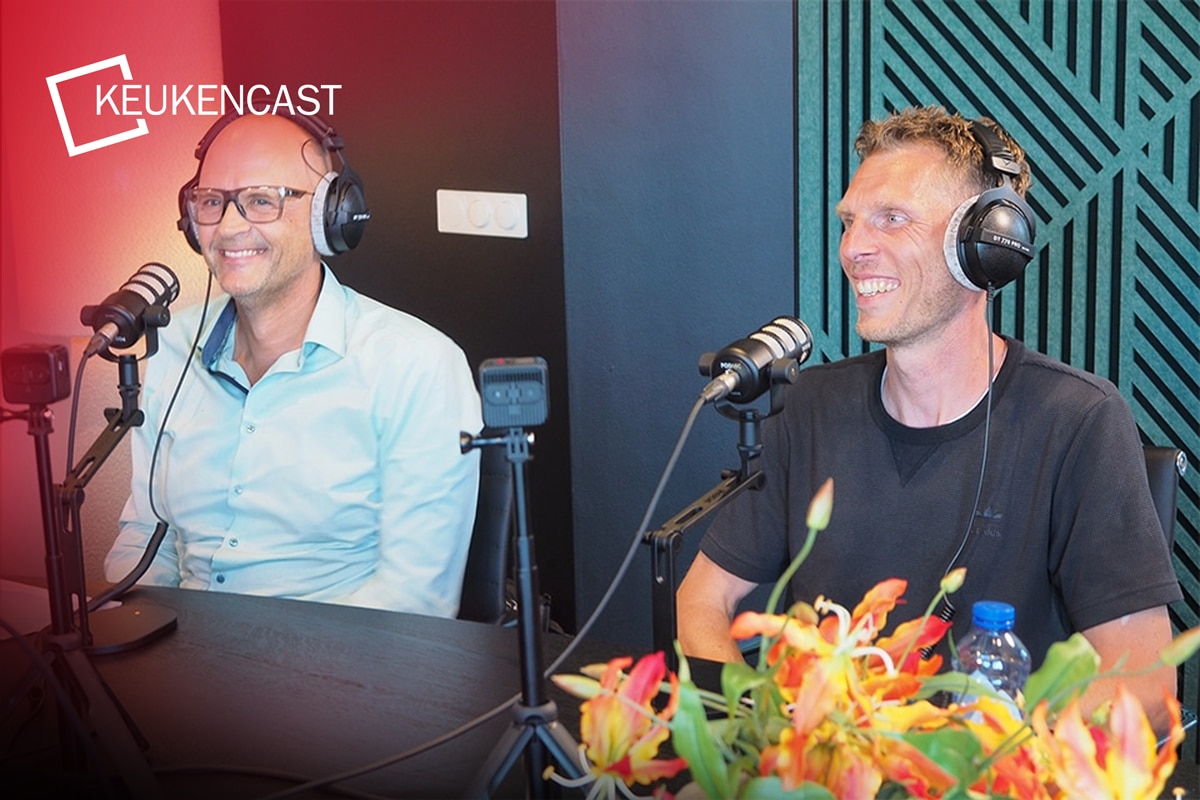
Jerry Helmers: This is Kitchencast, the podcast for trade professionals with ambition in the kitchen industry. In each episode, an expert sits down to discuss the most important trends, themes and developments. And we don't shy away from discussion either. At the kitchen table, on the kitchen table, under the kitchen table, we do it all. My name is Jerry Helmers, I am your host and presenter. I welcome you. Well, who are we sitting with here in the studio here in Weert at Lauwers Media Group? At the table with me is Simon Rombouts of Chainable from Gilze. Welcome.
Simon Rombouts: Nice to be here.
Jerry Helmers: Hearty to have you here. And on my other side is, yes, I said in another episode, is it the Johan Derksen of the kitchen industry? The grumbling sidekick. Well, the grumbling isn't that bad. But yes, you do have your role today, of course. I'm talking about Maarten Zegstroo. You too, welcome to the podcast. We are also looking forward to Maarten's minute, your guest column in the middle. Because, of course, we also let ourselves be surprised.
[01:10] Simon introduces himself
Jerry Helmers: First, a very brief introduction. Simon, for the listeners, who are you? Give some context. Who do we have here at the table, and who is going to tell all these interesting things later on? That they are interesting, that remains to be seen. You are responsible for that.
Simon Rombouts: Yes, that's right again. Simon Rombouts, one of the founders of Chainable. Chainable is a circular kitchen supplier for the business market. So think housing associations, investors, healthcare institutions, municipalities. Maybe a little different than the average kitchen retailer listening to this podcast.
Jerry Helmers: Kitchens will remain kitchens.
Simon Rombouts: Kitchens will remain kitchens.
Jerry Helmers: Or isn't it?
Simon Rombouts: Yes, it could be a little different, couldn't it?
Jerry Helmers: Yes, we may already have a point for later. But anyway, I'm interrupting you. Go on.
Simon Rombouts: Yes, we do that with a team of about thirty in Gilze, we are based. So at Tilburg about sixty different customers. And that may be very little if you have a private consumer kitchen business. But if you have a customer who orders four hundred, five hundred kitchens every year, it starts to get a nice volume.
[02:13] First impressions and introduction of Maarten
Jerry Helmers: So there is some money being made there in Gilze. Well, too bad this isn't being videotaped, now we could have seen some furrowed brows anyway. Yes, but anyway, are there any other things we should know about you that we really should never forget? Things about me that we should never forget? Now a silence falls. No, you really don't know. Maybe this podcast will be completely unforgettable.
Simon Rombouts: Well, let's hope so.
Jerry Helmers: Let's hope so. Maarten, who are you? Where are you from? And why are you the most critical kitchen columnist in the Netherlands?
Maarten Zegstroo: Yes, whether that is the case remains to be seen. You called me Johan Derksen before, that was already toned down a bit. So I kept it quiet last time. I'm Maarten Zegstroo, I'm almost 46 years old at the time we make this podcast. And I live in Purmerend and I've been working in the kitchen industry as a trade editor for fifteen years now.
Jerry Helmers: And that makes you an expert? And again, is there a silence in this podcast?
Maarten Zegstroo: Yes, now a silence falls. You have to boast with yourself then. That is always a challenge, because there is always something to learn. So then expert is always a bit of a sensitive term.
Jerry Helmers: Let me rephrase the question. Specialist.
Maarten Zegstroo: Yes, specialist indeed. Specialist I think so. I think the last few years, talking about the industry, I've seen more nodding people than shaking people down.
Jerry Helmers: What do you mean by nodding people? Yes-kinkers who thought everything was okay?
Maarten Zegstroo: No, it's not that bad, but just that I seem to have the same opinion or have seen or made the same test relative to other people who have been in the industry for years.
[04:09] Why the kitchen industry remains fascinating
Jerry Helmers: Okay, what makes working in the kitchen business so much fun? Why do you stick another 15 years on it?
Maarten Zegstroo: A family industry, in which people are competitors of each other, yet generally nice to each other. I was out of it for a year. I missed the industry and then I came back as an editor.
Jerry Helmers: What are you hoping for in this podcast?
Maarten Zegstroo: Well, it's obviously a fairly new side of kitchens for me anyway, because I don't know that business yet. I'm curious about the business and curious about the sustainable thinking behind it.
Jerry Helmers: All right, well we're going to see if that's going to work. But we're going to start with the propositions first. Simon, are you ready?
Simon Rombouts: Always.
[05:07] Sustainability statements
Jerry Helmers: Simon, I have three statements for you. Agree or disagree. Here comes the first statement. The kitchen industry should be legally forced to become more sustainable.
Simon Rombouts: Agreed.
Jerry Helmers: You agree. Aha, legal obligation, then. Thesis two: sustainability is too often a marketing term with no substance.
Simon Rombouts: Also agree.
Jerry Helmers: You agree with that as well. And then the last proposition for you: now, right now, ten years from now, the traditional kitchen concept no longer exists.
Simon Rombouts: Definitely agree.
Jerry Helmers: That time once. Well, it's easy to remember. Do you also want a thesis statement, Maarten, so that Simon also just put you in...
Maarten Zegstroo: Forward.
Jerry Helmers: I made quite a list. Let's see. For you, Maarten: sustainable building is mostly a matter of mindset.
Maarten Zegstroo: Agreed.
Jerry Helmers: You agree with that. Well, let's do another one. Consumers want sustainable, but they don't want to pay for it.
Maarten Zegstroo: Definitely agree.
Jerry Helmers: Definitely agree.
Simon Rombouts: I also agree.
Jerry Helmers: Agree as well, yes. Well, we're going to see if we can still get that little conversation going.
[06:20] What is sustainability anyway?
Jerry Helmers: Well, Simon, sustainability. You can't open another newspaper, you can't listen to another podcast, you can't buy a trade magazine. Sustainability, sustainability, sustainability. I'm getting a little tired of the concept of sustainability. Why shouldn't I get tired of that? Or explain what you mean by sustainability so I can get another fresh perspective on it.
Simon Rombouts: Well, yesterday was in the news, and it kind of snowballed very quickly, but Europe is warming twice as fast as the rest of the world. And we sometimes think...
Jerry Helmers: Yes, we're all talking about April 2025. Because people who, for example, would listen to this podcast, I'll name it, in July, are talking about April 2025.
Simon Rombouts: Exactly. And I think that very aptly reflects the fact that we think: we all get away with it. And if things continue as they are, in the way we're doing business now, there's really nothing to worry about. Or at least, then the problems aren't too bad. But doubling the warming, or at least accelerating the warming, is just catastrophic. Certainly even in our own country. And that's going to affect us. So somewhere, sustainability is very important to preserve a little bit of the livability of the planet. And indeed, improve it as well.
Jerry Helmers: But then what is sustainability? Because you've only told us now that something is probably going to happen to our earth and we're going to have problems in the Netherlands. But then what is sustainability?
Simon Rombouts: Yes, sustainability ensures that the earth actually remains livable by thinking well on different aspects. Something has to be economically sustainable. That could be that a product lasts a long time, but also that a product is just profitable, also for the planet. You could also look at it that way. It can be socially profitable. So you don't want the poorest people to be really squeezed out to make certain products. And you also want the environment to actually benefit. Ideally, you would like products to contribute to improving livability.
[08:13] Sustainability applied to the kitchen
Jerry Helmers: But in the end, how come it's not really a sexy topic anymore? I feel like there's a little...
Maarten Zegstroo: Because it has become a catch-all term actually.
Jerry Helmers: Yes exactly. So I still wanted to see to what extent we can frame it. Look, this is obviously Kitchencast, podcast for the kitchen specialist and every other professional in the industry. Define the concept of sustainability around the concept of kitchen.
Simon Rombouts: Yes, well, right now kitchens are made just in a factory. Often there are only a few big kitchen factories in the Netherlands. Most of the kitchens sold in traditional kitchen stores are made abroad, usually Germany. Those kitchens are now made from particle board, and that particle board is made from wood. Usually most of that is new wood. So trees are cut down for that to make board material. You can imagine that's actually maybe one of the worst uses of wood. You're better off building houses with it than shredding it and gluing it together to use it in kitchen cabinets. We have a very nice application, but in the Netherlands alone five hundred thousand kitchens a year are thrown away.
Jerry Helmers: Literally throwing away in the trash?
Simon Rombouts: Into the landfill and eventually into the incinerator. That's called in a fancy word: you have a high calorific value. In other words, that burns nicely. Our power grid is happy with it. But eventually all the value is gone. If we were to use these materials to make new chipboard from which to build our kitchens, we would save a lot of trees. And we can then use those trees again to build our houses from. That's one way of looking at sustainability. But because there are so many different views, because that was originally your question, and because people have also become a bit sustainability weary....
Jerry Helmers: Yes, I'm sure it did.
Simon Rombouts: Yes, of the concept. Also because nowadays people say: you can recycle our product, that's also very sustainable. Yes, but nobody talks about what materials you use to make that product for example. Well, if your definition is already so much different from my definition, then we're probably never going to speak the same language and we're never going to understand each other.
[10:22] The role of the kitchen industry
Jerry Helmers: But at least then you say: for the kitchen industry, we have to talk about economic sustainability, is there any money being made, you have to talk about social profitability. It has to make something for the earth, our society, and it has to make something for the environment. And so that's what you're saying, so we in the kitchen industry can do something about that or we can take responsibility for that?
Simon Rombouts: Definitely.
Jerry Helmers: Okay, are you a little bit sustainability tired, Martin? I see you kind of nodding like this of, yeah, I'm hearing this now.
Maarten Zegstroo: I definitely agree with the term container term, because it can be so much. Sustainability can also be: the kitchen can stand for twenty-five years in a house, that's also sustainability. Where for me largely the problem lies at the moment is that sustainability is now a choice. And I think we have to move toward the future that we can't even choose anymore, but that there is just sustainability. And of course they're already kind of going down that road, just the way Simon's company and organization is doing that, I don't know. So I'm very curious about how that works then.
[11:34] Why Chainable exists
Jerry Helmers: Okay, so you guys took an initiative on your own with Chainable. You started about five years ago. Can you briefly explain what Chainable, your company, stands for? While at the same time you also said that the kitchen industry should be legally forced to become more sustainable. But if there is an initiative of yours from the market, then maybe we don't need a legal obligation after all. So those are two questions I ask in one. What is Chainable?
Simon Rombouts: I actually want to start with that second one. Well, it's already literally becoming mandatory, it doesn't take long. From the extended producer responsibility, there are simply European regulations: you have to remain responsible for your products over the lifetime and you are also obliged to take those products back. The moment you take products back and the result is actually a worthless product, then it's not smartly designed. Whereas, if you have cleverly designed and you get the product back and it's a valuable product that you might be able to reintroduce to the market with a refurbishment, then you're also bacon.
Jerry Helmers: This is going to happen. Yes, but you also see the shift, politically, in Europe. In several countries, and we have also seen it in the Netherlands, some right-wing parties are coming to power and they look very differently at sustainability. Yes, you are right, there is already a certain commitment, also from Europe, but that momentum may well start to change.
Simon Rombouts: Yes well, that's right. And political left-right still sometimes shifts regularly.
Jerry Helmers: But the big goals and climate change do continue.
Simon Rombouts: Yes.
Jerry Helmers: It may actually continue, but if people don't want to participate in that anyway, I would almost say: then democracy is above the climate goals anyway. Surely we must ultimately do what the people want.
Simon Rombouts: Right. And at some point my view is that eventually the two are going to come together. People are going to want what's good for them, but also for the planet. Because indirectly, it's kind of crazy. It may be good for their wallets in the short term, but in the long term it's also bad for them, the children, the viability of the current climate.
[13:35] How a kitchen no longer becomes a waste
Jerry Helmers: Okay, but well, people will absolutely think substantially differently about that. And they will continue to make those other choices now. But anyway, you do say: that kitchen industry should be legally forced to become more sustainable, that's one thing, but you've also taken an initiative yourself. So Maarten, pay attention, he is now going to tell you what Chainable is.
Jerry Helmers: I'm going to sit right there. That's actually almost now your pitch. Tell me a little bit, I've also been to your showroom of course, I already know a very little bit of what you're going to talk about, but tell the listeners. How do you end up creating a kitchen that never becomes trash?
Simon Rombouts: Because we were talking about those five hundred thousand kitchens at the beginning of our conversation. And that's a huge waste problem. How could we make sure that we can create a kitchen that will last a lifetime? That's designing a kitchen in a completely different way. So we actually started with that philosophy. And we started looking: can we make a kitchen with less material, for example? Because that's actually a very simple way to incorporate sustainability. Yes, you can. You can design a kitchen by not using double walls, for example. Because if you put cabinets next to each other, you get double walls.
Jerry Helmers: How simple is it really?
Simon Rombouts: Yes, how simple is it? You can save forty percent in materials that way.
Jerry Helmers: Yes, please continue.
Simon Rombouts: You can of course work with more durable materials that might last longer, have a longer lifespan. You can think in a completely different way about: gosh, if I no longer make that corpus out of chipboard but, for example, out of a modular clickable steel frame, then I do have a system that might last fifty or sixty years. So you also have ways of shaping sustainability in a different way. That says a lot just about our product and how we designed that product. But sustainability we also think is very important that those products that are in our kitchen already have a reclaimed origin. So we already apply reclaimed materials. Our kitchen is 88 percent circular. That means we've gone through almost every component in our kitchen to see what is most needed.
Jerry Helmers: But then you're also talking about worktops, for example? Are you then also talking about grips?
Simon Rombouts: Everything. Back panels, sockets, countertops. And with some aspects it's a little more difficult. For example, appliances, that's very complicated to do that with reclaimed materials. But all the mono materials, particle board, countertops, there that's just possible. There you can make the right choices. Then we make sure we keep a grip on those materials. That also brings back a little bit the statement of: okay, we have to be obliged to take responsibility for the products we make for longer. We make sure we have a circular business model around our kitchens, so we always get those materials back.
Jerry Helmers: Yes, it's called that in fifty years? In sixty years?
Simon Rombouts: Yes, because our customers, housing associations, also operate them. Not the average consumer buys a kitchen after eight, nine years when we move, for example. And a housing corporation, an investor, leaves a kitchen here for twenty years and for seventy years they operate the property. So those timelines are much more in line with also a much longer product life.
Jerry Helmers: And that's basically what you guys do, has been the start of your business.
Simon Rombouts: Yes.
Jerry Helmers: An ideological objective I would almost say.
Simon Rombouts: Yes, but always at the interface between where you can make an impact and, of course, where it's just economically profitable. Because our customers can save an incredible amount of money by applying our kitchens. So there you see that there is a very interesting intersection, that sustainability is not at all a stupid idea that has to cost more money. No, it's actually a very, very big opportunity.
Jerry Helmers: Maybe by doing that you also make sustainability sexy again when people think, oh, it's affordable after all.
Simon Rombouts: Yes, well, I hope so. And you also get a better product in return.
[17:12] Why standardization is important
Maarten Zegstroo: You have now delivered this story from Chainable. Yes, respond. I hit on the term sexy, so to speak.
Jerry Helmers: Yes.
Maarten Zegstroo: Also, because you have chosen to have care facilities have a different business model than people at home. Is there a reason for that? Does the way you guys work have to do with that it looks different in terms of look and design? That it's more suited to that kind of customer than my mom and dad would buy it? In such a way sexy too.
Simon Rombouts: Yes, consumers walk into a standard kitchen store and you can choose a hundred and fifty different colors. At the end of the day, that's not very easy to make circular. Because you have a lot of customization in an average kitchen store. You have a lot of choices. And precisely in standardization is the key to circularity. That's a lot easier to then reuse products there, to offer after-delivery guarantees, to offer refurbishments in the future, for example. And that's only possible if you only work with a small assortment. So therein is actually this whole proliferation of everything is possible, I'm paying and that's the consumer of course, so I want what I want, which is a bit more limited in the business market and therefore a bit easier to organize that way.
Jerry Helmers: Yes exactly. Is it promising, with your assessment?
Maarten Zegstroo: In the industry he's in now, with the things that are possible now, that's promising.
Jerry Helmers: Why is that promising? Because housing associations simply have ears for that?
Maarten Zegstroo: Yes, I think so. Because they look at the long term much more than the average consumer. And also can have a bit more social approach and not have the premise of: my neighbor must like the kitchen.
Jerry Helmers: Obvious say, but okay, that's nicely substantiated indeed.
Simon Rombouts: They like it, too, you know. A Chainable kitchen is a more beautiful product than a traditional kitchen. That's on top of it.
[19:15] Can this also work for consumers?
Maarten Zegstroo: No, I was indeed wondering whether in the future there might be ideas to... Because it does sound very noble. And I can imagine, again, I just indicated as well: as long as sustainability is a choice, people will look at their wallet what sustainability costs. That is also one of the propositions that I certainly said once. But is it possible in the future?
Jerry Helmers: For consumers.
Maarten Zegstroo: For consumers.
Jerry Helmers: Yes, you were but indeed.
Simon Rombouts: No, that too. So we too are taking steps to offer more and more. But anyway, maybe you should say: okay, one hundred and fifty is actually also crazy and let's reduce that to thirty colors. Then there should be something for everyone. I think that is already an improvement. Then in terms of materialization, I'm really talking about materials that are used. Almost all materials can be made circular. Indeed, it is very often chosen with the wallet in mind. But the moment you can get people to think: you choose with your wallet now, but the moment you choose this material, it will last much longer and you can save so many costs. You can make it insightful. Then I think quite a few consumers might be willing to pay a little more.
Jerry Helmers: But do showroom salespeople have the time to make that insightful? They're kind of fast guys in that showroom, aren't they?
Simon Rombouts: Yes, of course. But then you as an organization have to contribute to that that it can be very easy. Look, a well-known example is of a kitchen countertop. Yes okay, we have to turn that sale quickly. Okay, I'll put an HPL top on it. That's one of the cheapest products you can put down as a kitchen countertop. You know once a hot pan gets on there, or maybe just around the seams it opens up a little bit, water gets in there. Then you can replace that whole top. That's relatively a very expensive replacement. If you do have composite, ceramic or natural stone, then you do have a material that is much more resistant to, say, water damage.
Jerry Helmers: Then it's in that price that is offered. And if the difference in price, I don't know, per worksheet is three hundred euros higher, it's still three hundred euros anyway.
[21:32] Sustainability must become the norm
Maarten Zegstroo: Yes, I think that's where the problem lies as well. And I myself am not necessarily a proponent of sustainability right now, because I also as a consumer on that, certainly say, I am also looking at my wallet. But I would like to see the term sustainability disappear in the vein of eco-friendliness and circularity as part of those terms, because everything is just sustainable. And then maybe it would also be a good try-out to put a kitchen somewhere once and not put rock hard at the top of it saying this one is 88 percent circular, and then see what the reactions are. I'm quite curious about that.
Jerry Helmers: Isn't that a fun experiment you'd like to try?
Simon Rombouts: Definitely. Well look, in the business market we have actually done a similar experiment already. In this case, a tenant was allowed to choose between a traditional kitchen and a Chainable kitchen. That was a project, a total of 154 homes in Helmond. There, 85 percent chose Chainable. And halfway through we started evaluating of gosh, why does 15 percent still choose ....
Jerry Helmers: Yes, why?
Simon Rombouts: And that turned out because we didn't have one color. A certain anthracite, we added that. And in the second phase, we got 92 percent.
Jerry Helmers: Yes, that leaves 8 percent, but it does indicate that people...
Jerry Helmers: But then what was the reason they chose it? Did they choose it because of the price?
Simon Rombouts: No, but there was no price difference. And that was the fine thing.
Jerry Helmers: Ah okay, there was no price difference.
Simon Rombouts: No, because a tenant simply receives a home with a working kitchen. Of course, the moment the tenant orders his or her own equipment or, for example, extensions from us, there is a price difference, because those modules are slightly higher in price.
Jerry Helmers: So basically what you're saying is, the Chainable kitchens are just hearty too.
Simon Rombouts: Definitely. And you also shouldn't make a product that is a goat's wool product. You want to make a product for the masses. Because only then can you make impact again. And is again that interface between it has to make economic sense and also be ecologically sound.
[23:35] Martin's minute
Jerry Helmers: Are you also so curious what Maarten's minute is going to look like? What Maarten is about to tell us in his column? I am very curious.
Jerry Helmers: Are we, because we're pretty much in the middle of this podcast, so it's time for Maarten's minute. Are you ready for it? Come on through.
Maarten Zegstroo: Sustainability, we can't ignore it anymore. In traffic, when shopping and yes, then of course also in the kitchen. But what exactly is it, a sustainable kitchen? Is it about recycled materials, a cooktop that uses less electricity or a cabinet that lasts twenty years? We actually just talked about it. For many consumers, sustainability still feels a bit like an extra. Something that is nice, as long as it is not more expensive. Because fair is fair, most customers do want green, but not if it leads to red numbers in the bank account. Still, you see something changing. Young buyers in particular are asking more and more questions. Where does this wood actually come from? And what about energy consumption? Interest is growing and that's good news. Today you're our guest, Simon, and I'm really curious. What does the ultimate sustainable kitchen look like to you? And how do we get there?
Jerry Helmers: Well Simon, this was Maarten Zegstroo's spoken column. He asked you a question. What does the ultimate sustainable kitchen look like and how do we get there? We want to know that answer.
[25:06] The ultimate sustainable kitchen
Simon Rombouts: I think it's very good to realize that sustainability is always more expensive as long as pollution doesn't cost anything. And that alternative, we actually look at that too little. In that case you would actually have to tax pollution as well. And then you will see that some choices suddenly turn out very differently. And then you won't automatically choose the cheapest, then probably the most sustainable option. My vision or dream in that is that we can develop the most sustainable circular kitchen, offer it to the market and for a consumer, for example, market it as a service. Why does a consumer have to own such a kitchen when we can then offer the service of always having a nice kitchen, that you can refurbish, that can grow with you and is adaptable to your needs... Maybe you have a family expansion and you think: yes, I won't be able to get by with this kitchen anyway. I would have liked a combination microwave instead of an oven. Well, that you can exchange that very easily, that you're really going to pay for use. I think that's also a very interesting trigger to take away that bit of extra price, which sometimes the consumer experiences as the barrier to choosing sustainability.
Jerry Helmers: Yes, satisfied again with this answer?
Maarten Zegstroo: Yes, I am curious to know how we are going to get there in the end. Yes, as long as there are opponents we won't get there one, two, three. As long as it's more expensive we won't get there one, two, three. So I'm curious about ... you delve into that more than the average person even me, am curious about how you look at that. Yeah, how do we get there?
[26:40] Fair pricing and hidden environmental costs
Simon Rombouts: Yes, there are a lot of parameters to turn to. And one of them is: are we paying a fair price for certain products now? And I think the answer to that is no.
Jerry Helmers: But then I think you also have to define now: what is the definition of a fair price?
Simon Rombouts: Right. Do we include environmental costs, for example, in these calculations? And so if we are going to do that, then you get that certain materials, or for example equipment made in China, are going to be priced differently than maybe some higher quality energy efficient equipment made in Europe. Then you can already see that there's going to be a benefit to the consumer in that. That's the first one. On the social aspect, you also see that more attention is being paid to how to ensure that everyone in society can continue to participate. How can I ensure that people with a distance to the labor market, for example, remain involved and stay connected in this society. That also means if you have sustainable products, that they meet those needs. Not just outsourcing everything as cheaply as possible and then we'll see.
Jerry Helmers: So there you are again talking about that social profitability.
Simon Rombouts: Yes, exactly. Yes, there are quite a few different aspects to it, parameters that you can turn to. And I also hope that the moment new materials, they cost relatively little now, and just labor to fix something up, for example, that is relatively expensive. So where we all have to go is that, and this is really macro-economic, it has been completely calculated by very large consultancies, is: how can we actually reduce taxes on labor and increase taxes on new products in particular, so that it becomes cheaper to refurbish a certain product or to design it to be refurbishable, to make it refurbishable, than it is to buy a new product.
[28:35] Should the industry be forced out?
Jerry Helmers: But then maybe there's a point in that? Because the first proposition I put to you was: the kitchen industry should be legally forced to become more sustainable. So is that maybe a point that we should somehow start mandating?
Simon Rombouts: Yes, this applies to all, not just in the kitchen industry.
Jerry Helmers: But anyway, we're obviously in that kitchen business here, Kitchencast. But is this then a point that you say of yes, we could maybe use some stricter laws and regulations on that, to get this done?
Simon Rombouts: Definitely. Yes, and I also think that at some point as an industry you can just start demanding: we only want products where we are going to increase the amount of recyclate every year, for example. Good steps have been taken, though. Average kitchen suppliers are somewhere around 40, 45 percent recyclate. But yes, what can be done now is 90, 95. So if we all just say as a market: okay, here we go, because we all have to or we want to. Especially also if we see that it's just economically profitable. Yes, then we will just take small steps to make sure that those linear disposable kitchens no longer exist and that the sustainable alternative is always chosen.
[29:51] How do you make sustainability interesting for retail?
Maarten Zegstroo: What I'm still curious about, Simon. I sometimes feel - and not everyone will agree with me on this, mind you - like a kind of mouthpiece for retail as editor of a trade magazine. How can we make it interesting for retail to make sustainable choices in the showroom?
Simon Rombouts: I also think you can earn more from sustainability, frankly, also in the longer term. You also get a different business model. A well-known example: when we came to a furniture hardware supplier and we said: we actually want a refurbishable drawer guide, is that possible? Because sometimes, after those disposable kitchens, the drawer guide is still good, but the whole kitchen is actually no longer your taste, well then that gets thrown away. That's actually a waste. Yes, we want to develop that. I said: but I also want to pay more for it. I want to pay 30 percent more for it the moment I can refurbish it. Well, only then did the eyes open. So for a retailer like that, you have to start looking precisely for models where again that economic and ecological profitability comes together.
Jerry Helmers: But now make that very concrete. The listener, there are a lot of kitchen retailers listening to this podcast. They have at some point taken all of this to themselves. The delusion of the day starts again. The next customer steps into the showroom. But how do they take it in those showrooms, in those kitchen specialty stores? If necessary, how do those director-owners of those stores, how do they specifically address that?
Simon Rombouts: Yes, well, one way I would suggest is: how do you make sure you remain responsible for that product? Longer than the warranty. Because at the moment, the business model is: I want the day the warranty expires, I want that kitchen to be able to collapse. Because yeah, chances are you're going to buy a kitchen from me again. If you want to break that, then you have to start thinking about: what kind of activities can I do over the lifespan that will just give me revenue, that will allow me to do kitchen extension activities or preventive maintenance, for example.
Jerry Helmers: But then you say, dear kitchen specialist, try extending the warranty periods and including other conditions in them?
Simon Rombouts: Or to include a service contract, for example, that you say: hey, I'm going to visit that kitchen after five or ten years and then I'm just going to have a look at the products. Is it still in good condition or is it still according to the customer's wishes? Because then I can then ... yes, you sold that kitchen, you added a lot of value to it, you sat down with that customer, you invested quite a bit of time, you may know that kitchen better than anyone else. You may also be the party best suited to then refurbish that kitchen again with maybe only half the materials, but maybe some serious sales.
Jerry Helmers: So it's also dealing with your customers and your contacts with the customers in a different way. Maarten, is this promising?
Maarten Zegstroo: I do think this is exciting, but that has purely to do with the fact that the accounting department would have to calculate how much revenue that generates or is going to cost. On the basis of: if your kitchen now lasts 25 years later, so you only buy one kitchen in 25 years to someone, which is now 10, 12 years I think. That's where TomTom almost broke down once by building very too good navigation systems where nobody thought: I don't need a new one because mine just still works. So it's kind of an interesting module that I don't have an answer to right now, because I can't make that calculation. Because it could just be that if you indeed take out that service contract, that that will eventually generate enough revenue even in those 25 years.
Simon Rombouts: It's guaranteed revenue. I still think so, too. Of course, you also have no guarantee that that consumer will come back to you. And by still staying involved and building that good customer relationship, even over a longer lifespan, you have almost a 100 percent guarantee that you're going to do that refurbishment as well.
Jerry Helmers: Exactly. And you have no guarantee that you can deliver the next kitchen.
[33:45] Sustainability as a new standard in the supply chain
Jerry Helmers: But then don't you also think that that kitchen specialist needs to look further up the chain with his suppliers? Because if you're going to stretch your warranty terms or make them nicer or make them more useful, surely you need other links in the chain.
Maarten Zegstroo: Yes right, it's also just how you look at it. Now we are still selling sustainability as a USP. Whereas I indicated earlier that I actually have the idea that in an ideal world, sustainability would soon no longer need to be sold as a USP, because we all stick to the rules. But I do find it an interesting subject to talk about, because there may be retailers who say: well, I'd like to think about that at some point, how about that. But it won't work on its own. There will have to be a movement, whether it's a purchasing organization, like MHK or De Keukenkring, or large organizations like Qudett. Those will really have to embrace that and take a hard look at what that's like. Because a mom-and-pop store, which is what we're talking about, simply doesn't have time to figure that all out on their own.
Jerry Helmers: Simon, so in ten years the traditional kitchen concept will no longer exist. You said at the beginning about this statement: I agree. But is this then hope, wishful thinking or with a factual foundation?
Simon Rombouts: Well, I already see that happening. When I started, five years ago, it cost 80 euros a ton to get rid of particle board, the main component of the kitchen. Now 15. I think within five years we will break through that it makes money to recover materials. So then, if you're a kitchen retailer and you've agreed with your customer that you're going to remain responsible for that product for a longer life, that also means that you keep a grip on those materials. That means you are allowed to take them back originally. Those materials are worth money.
Maarten Zegstroo: Old paper collection.
Simon Rombouts: Actually collecting scrap paper. Well anyway, as those materials become worth money, you have another advantage. In the second kitchen life, you can buy it cheaper than a traditional kitchen. And so in the end you have a positive reinforcing effect which is going to make sure that you actually only sell circular and that linear can no longer compete. So yes, that's the end of the disposable kitchen.
[35:54] Where Simon's motivation comes from
Jerry Helmers: Where does your incredible passion for sustainability and the environment come from? Pooh. Because you started this five years ago. I think you worked at a bank before that.
Simon Rombouts: Yes, I originally studied in Utrecht, Sustainable Business and Innovation. And I actually did research at the bank on how to make circular, sustainable business models financeable. This is also difficult from a bank perspective. The moment you have a residual value, for example. We have a residual value on our product of 25 percent. That means you're really only at 75 percent risk. So for banks, that's really a very big advantage, because that means you're out of cover sooner, what they call it. And so actually you also have to charge a lower interest rate on a circular model. That in turn can be an interesting trigger to sell more circular products as well.
Jerry Helmers: And so you see ... where does that interest come from? Is it mostly also your daily concern for the environment? You just became a father and if you want your little one to last another eighty, ninety years even as an octogenarian?
Simon Rombouts: Yes, I think keeping the planet livable, also for future generations, especially now that I also have a little one, again, has been extra a motivation. But I've always had it. My parents were fairly sustainable-minded, well just normal. So in that sense no geeks. But the fact that it makes sense and that I always wanted to be on the interface between making impact and economically logical choices, I find that very interesting. Because if we do that with companies, what a giant force for good we can all be.
Jerry Helmers: Yes, now to convince the critics in society that it really should.
Simon Rombouts: But no, that it makes money. And if it makes money, so do the critics.
Jerry Helmers: Yes, you may have a point there.
Simon Rombouts: We prove that every day.
[37:46] Latest comments at the table
Jerry Helmers: Yes, that's true. We're almost at the end of this podcast. But I'll look at Maarten to see if you want to give one last bouncer. Because we're about to go to the commercial two minutes of Chainable, of course.
Maarten Zegstroo: True, true, true. No, I must say, I'm not convinced, but charmed.
Jerry Helmers: So what did you become unconvinced about?
Maarten Zegstroo: I think the road to it is incredibly long, from the point where we are now. But I had just indicated it a little bit as well: if a major party embraces it and they would start calculating such a module and it comes out positive and it persists indeed that surrendering makes money, yes, then we are moving towards the integral world.
Jerry Helmers: But are you saying then, I had not put that proposition to you at the beginning, but I had put it to Simon. Are you saying then that the kitchen industry should also be legally forced to become more sustainable? Because then of course at that point we are also talking about the way forward. Do you then say as the conclusion: agree or disagree with that proposition?
Maarten Zegstroo: At some point in the future.
Jerry Helmers: Oh, how careful we are again. Then you invite a columnist who gets to sit in here every time and they're still as careful as I don't know what. Anyway, part of the job.
[38:56] Simon's last two minutes
Jerry Helmers: We're moving towards the last two minutes of this podcast. Simon, you know, two minutes are literally all yours, too. Two big advantages: Martin says nothing and I say nothing. I would say, keep a look out for the clock. It's entirely up to you what you want to talk about. You might want to return with an afterthought to what we've discussed here in this podcast. But I'm also totally fine with you bringing Chainable to your attention again. Are you ready for your two minutes?
Simon Rombouts: Certainly. Well, in the last conversation I was able to explain a little bit about circular and sustainable. And in particular also that you can combine that and that it is a very logical business model. But I can well imagine that the listener now says: yes, I still don't know where to start. I think a couple of things you can do: go first, can I take a product back once? Maybe you have kitchens, you've been in the business a hearty long time and you think: I put a kitchen in there twenty years ago. Go see if you can take it back. Go see what value is in that. Go see if you can leverage that value in some way. I find that very interesting. Can you maybe add certain services within your current range to say, can I do life-extending activities, can I do a refurbishment, can I otherwise get an additional service and therefore revenue out of that as well? I think a lot of companies want to be perfect right away. You can't be perfect right away. We have to take small steps. When we started, our kitchen was only 79 percent circular. If I had waited until it was 100 percent circular, I still wouldn't be where I am. Right now I'm at 88 and I need my suppliers to do that. So we can't do it alone. We all have to take those little steps together, and that's what ultimately gets us towards that circular society. And I understand that sometimes that sounds really big, but let's just start small. It literally starts at the kitchen table. I find this kind of conversation very useful in that to also increase support a little further. Let's also make it easy for that salesperson to sell that more sustainable, circular or energy-efficient alternative. So not that it should cost them a lot of effort, no, it should be able to go along with that flow. And if interesting care institutions, housing corporations or other parties who exploit real estate in a certain way are listening and think: I want a product that is both circular and can save me a lot of costs, then Chainable is the place to be.
[41:26] Closing the episode
Jerry Helmers: Literally at three hundredths of a second you neatly filled your two minutes. Well, we don't often experience that in this podcast, because of course everyone gets their two minutes of commercial or free speaking time at the conclusion. Very well done, nice closing speech. Did you enjoy being a guest here at all? Because obviously you made the drive from Gilze, no, you came from Boxtel this morning, drove from Boxtel to Weert, you have to go back later. Was it worth it?
Simon Rombouts: No definitely. I actually haven't thought about it fully, but Chainable stands for a chain change. And that means we want to change the kitchen industry as a whole, and we're doing that in the project market. But I hope there are people listening who are thinking, but I can do this too.
Jerry Helmers: And so you grab another thirty seconds of free speaking time, huh. Yes very good, in charge of what you say yourself, you do that well. But you liked it. Do you want to come back again?
Simon Rombouts: Always.
Jerry Helmers: Good. Maarten, was this a nice guest?
Maarten Zegstroo: Super fun.
Jerry Helmers: Even though you weren't completely convinced about everything?
Maarten Zegstroo: No, but it's something I can also learn and I found it very interesting and informative for me.
Jerry Helmers: That's absolutely beautiful. I also take a look at the engineering guys. Did you guys find it interesting? Shout out. Yeah, shout at the back indeed. Very good. Thank you for joining us. You've been listening to Kitchencast, the podcast for trade professionals with ambition in the kitchen industry. My name is Jerry Helmers and I was your host and presenter. Thanks to our regular sidekick and kitchen expert Maarten Zegstroo.
Simon Rombouts: Will you, dear listener, also drop by Kitchencast?
Jerry Helmers: Would be nice. Check right away www.keukenbouw-online.nl.
Simon Rombouts: You are most welcome.
Jerry Helmers: Technology today in the hands of Daan Halters and Mark Schouten, project manager Folkert van der Werf, editor-in-chief of our trade magazine is of course Suzanne Peek. Keukencast is a production of Louwers Mediagroep in Weert. Until the next episode, until the next Keukencast.